

Helen & Alice:
A Waikīkī Couple
by DeSoto Brown
Same-sex relationships, sometimes lasting lifetimes, have always existed – but our knowledge of them in the past is sketchy. Only rarely do descriptions and pictures of such connections survive to give us insight into these human interactions.
By chance, a female couple in Waikīkī were the neighbors of photographer and amateur historian Ray Jerome Baker, who first visited Hawaii in 1908 and moved permanently in 1910 with his wife and young son. Baker lived in a two-story home at 1911 Kalākaua Avenue which also served as his photo studio and darkroom; he later purchased this house and then another. In addition to taking tens of thousands of photographs in his lifetime, Baker researched and gathered the history of the city of Honolulu. He also kept diaries for many years. He donated most of his pictures and writings to Bishop Museum, which is why the story of his neighbors Helen Richardson and Alice Perry was documented and can be told today.
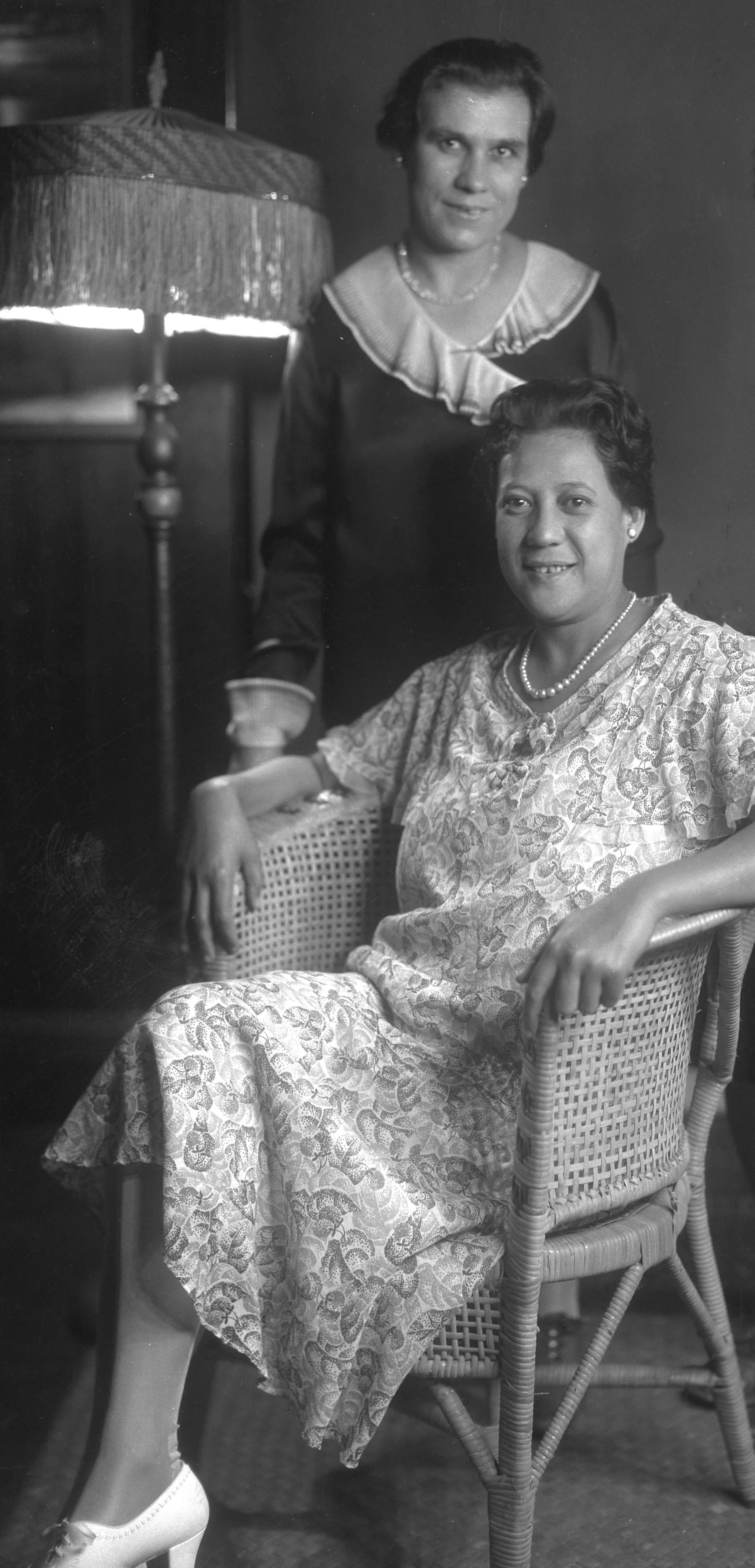
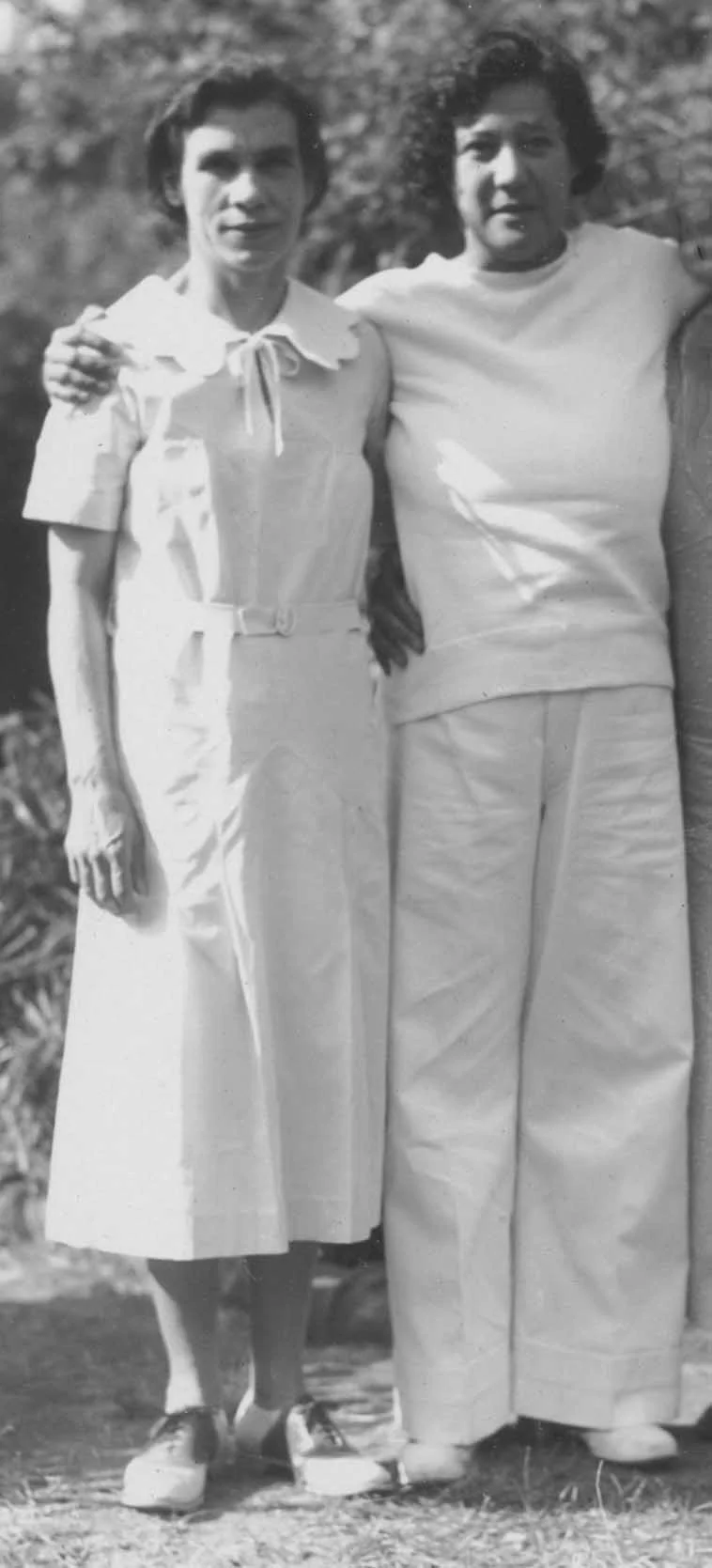
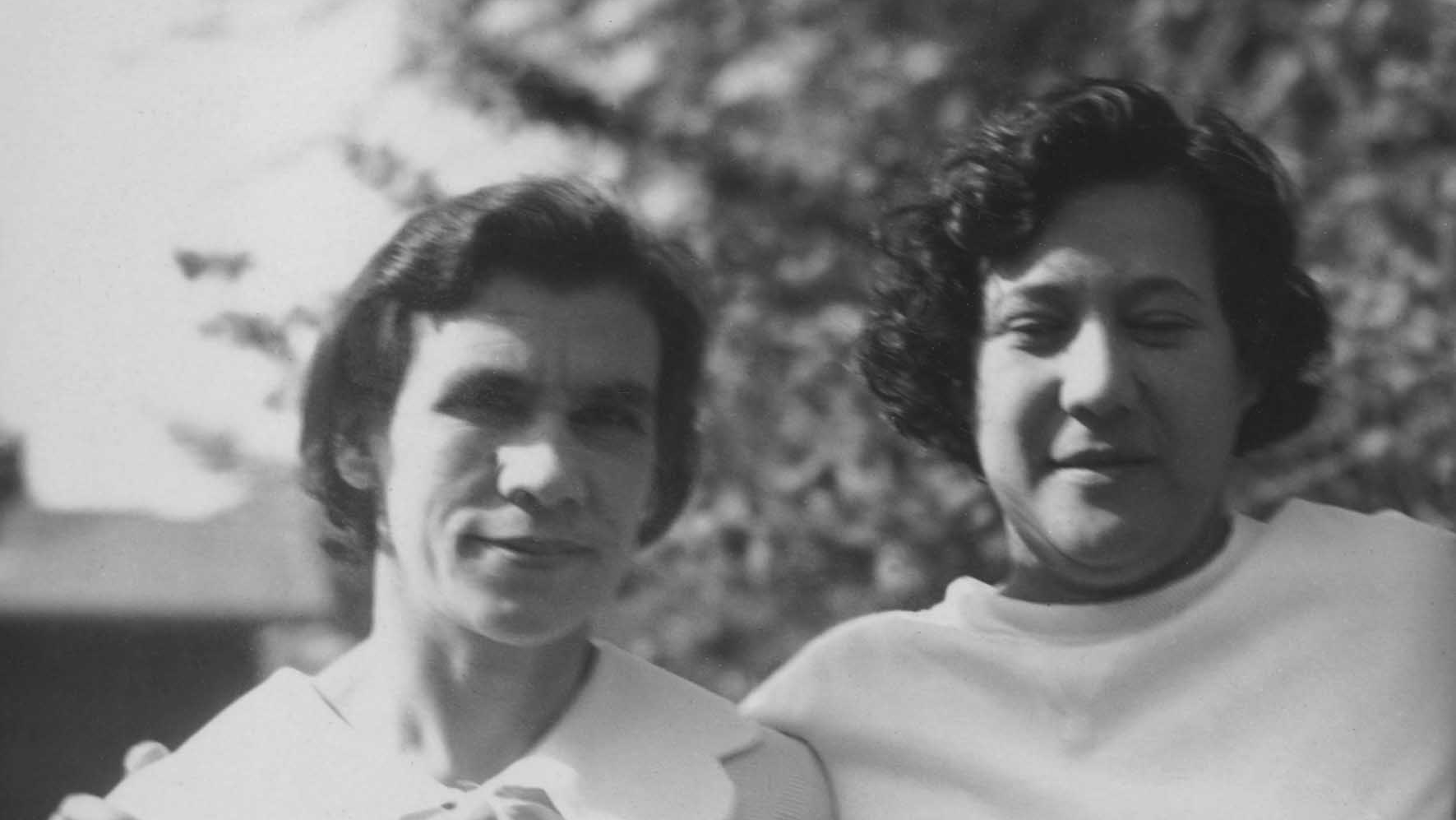
Alice Perry and Helen Dudoit Richardson as photographed by their neighbor Ray Jerome Baker; first in his photo studio in their dress-up clothes in 1930, then informally outdoors in 1933. (Bishop Museum)
Helen Dudoit Richardson appears to have been a member of the long-established Hawaiian-haole Dudoit family. Her father Charles Dudoit purchased an existing small wooden house in Waikīkī in about 1901 which was also when his daughter Helen was born, likely in this same home. There were at least five children in this family, and two of Helen’s brothers were older than she was, having been born in the 1890s. (It’s not known why the children carried the last name Richardson, different from their father.) During this time this area was still mostly wetlands; rice was cultivated and ducks were raised in ponds. In 1927 the house was enlarged with an addition at the back. It survived at 478 Ena Road until 1965 when it was demolished for the construction of a two-story commercial building which presumably is the same one on the site today (2026); a small newspaper article stated at the time that this family home had been one of the oldest surviving houses in Waikīkī.
Helen’s father placed this property in a trust which was administered by the Bishop Trust Company, and she presumably was paid by the company from proceeds that included rent from tenants in other structures on the site. This income apparently meant that Helen did not need to hold a job although she was identified as a teacher at Iolani School from 1921 through 1924.After her death, the land was to be donated to the Children’s Hospital. Baker wrote in 1963 that Helen “always talked big about her property” and this attitude led to significant problems in the 1940s and ‘50s, described later.
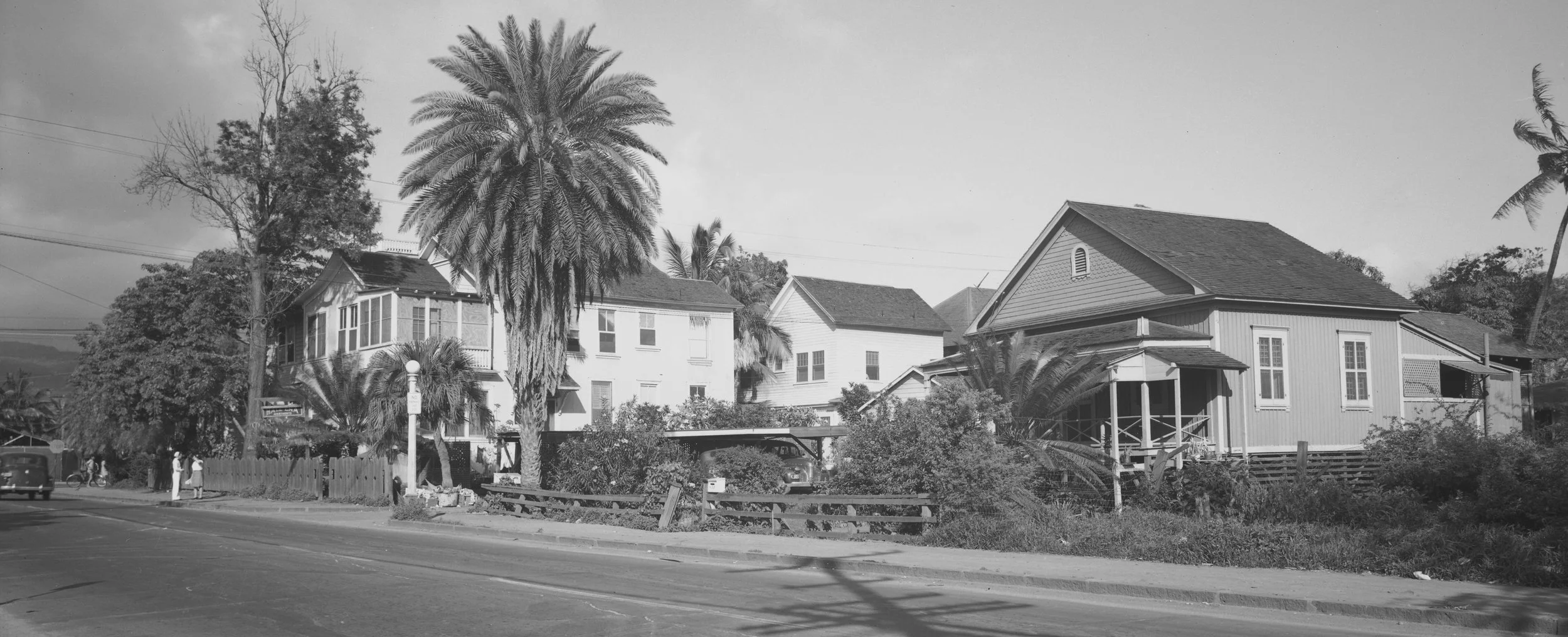
It's hard to imagine this 1944 scene could be in Waikīkī. On the right at 478 Ena Road is Helen Richardson's family home where she and Alice Perry lived. On the far left is the Kalākaua Avenue intersection. Obscured by the roof of Helen's house and just visible on its left edge is Ray Jerome Baker's roof at 1911 Kalākaua Avenue. (Bishop Museum)
Two Personalities
The personalities of the two women were reflected in their relationship. In 1944, Baker described Helen as “deaf, good-natured, yet bombastic, autocratic, decisive and vigorous.” Of the two, she was what today would be called “butch” while Alice was certainly more of a homemaker, and definitely not as assertive. At a dinner one night in 1944, Baker described Alice’s role:
Alice did the preparing of the meal and the listening[;] also Alice did the explaining and the conveying of questions when Helen failed to hear.
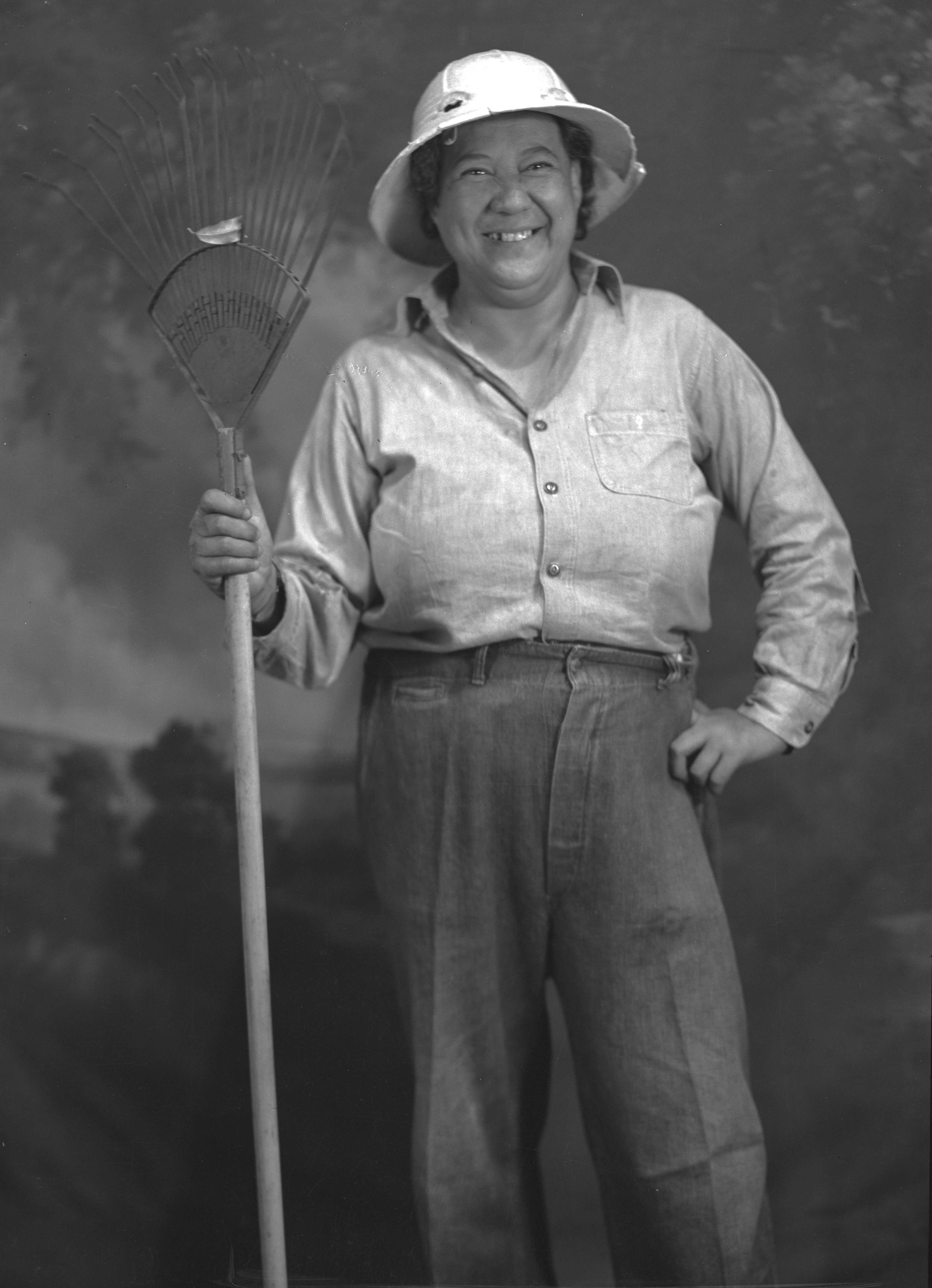
Helen Richardson as she often looked, dressed in men's clothes. Baker wrote that he took this photo "when she was in a happy mood", which she frequently was not. (Bishop Museum)
At times Miss Richardson put on men’s clothes, and acted like a plantation luna [boss].
When she became liquored up she acted silly and made drunken love to men, though ordinarily when sober she had nothing to do with men.
The women’s personalities were reflected in their work during World War II, a period of social upheaval and major changes in everyone’s daily lives in Hawaii.
Baker wrote that starting in 1942 Alice had worked making camouflage netting material a short distance from their Waikīkī homes. This project had partly been created at the start of the war to provide jobs for lei women, who had lost their primary source of income selling lei at the Honolulu Harbor docks on days when passenger ships left. This was because tourist travel had been immediately prohibited, and all ship arrivals and departures had been made secret.
Helen’s war work was far different. Somewhere near Fort Shafter she and a number of other women of different races refilled used metal ammunition shells – from small individual bullets for machine guns to large artillery shells – which had been salvaged from battlefields. At the ordnance department where she was employed, these empties were straightened and dents removed. They then would be filled with live gunpowder to again be ready for firing. The metal shells sometimes arrived “covered with the gore of battle, with foul smelling and decomposing blood and flesh smeared all over them;” Helen “shuddered as she told of the stench they had to deal with sometimes.” She also criticized the other female workers who could be
…careless in connection with critical and exacting operations and how they endangered themselves and others sometimes with their lack of interest or inattention to details.
Helen told her story with dramatic emphasis and when she had finished warned me not to tell what she had told.
Conflict
The women’s relationship was not uniformly smooth. Baker wrote:
There was a bitter fight between Alice and Helen…Alice came and told me that Helen was drunk and that she could not live with her anymore. Told her she better come and stay in my house until she could make other arrangements. She brought clothes, personal effects and many bundles…Was much depressed. In the meantime Helen was full of booze, and ugly… (August 17, 1945)
Alice remained much of the day. Toward evening she decided to go and cook dinner for Helen. By this time Helen had become sober and after she had dinner which Alice had cooked, became agreeable again. Alice came back and said she had acted too hasty and that she was going back again. (August 18, 1945)
Helen’s alcohol intake was major problem.
A bottle of beer sat in front of her plate and it was hers, without explanations or invitations to the others, exclusively.
Helen got to drinking a lot. Alice…tried to keep her sober.
In the late fifties she became a heavy drinker and was drunk much of the time. She became such a pest that all the liquor establishments forbade her to drink in their places…Alice would go out to buy liquor for her.
More Conflict
From 1948 to at least 1956, Baker and other neighbors were embroiled in a dispute with Helen over her claimed ownership of Dudoit Lane, an unpaved alley next to her house that allowed the others access to the backs of their residences, including their garages.
At times she took a hammer and smashed headlights of unauthorized cars that paused on her side of the lane.
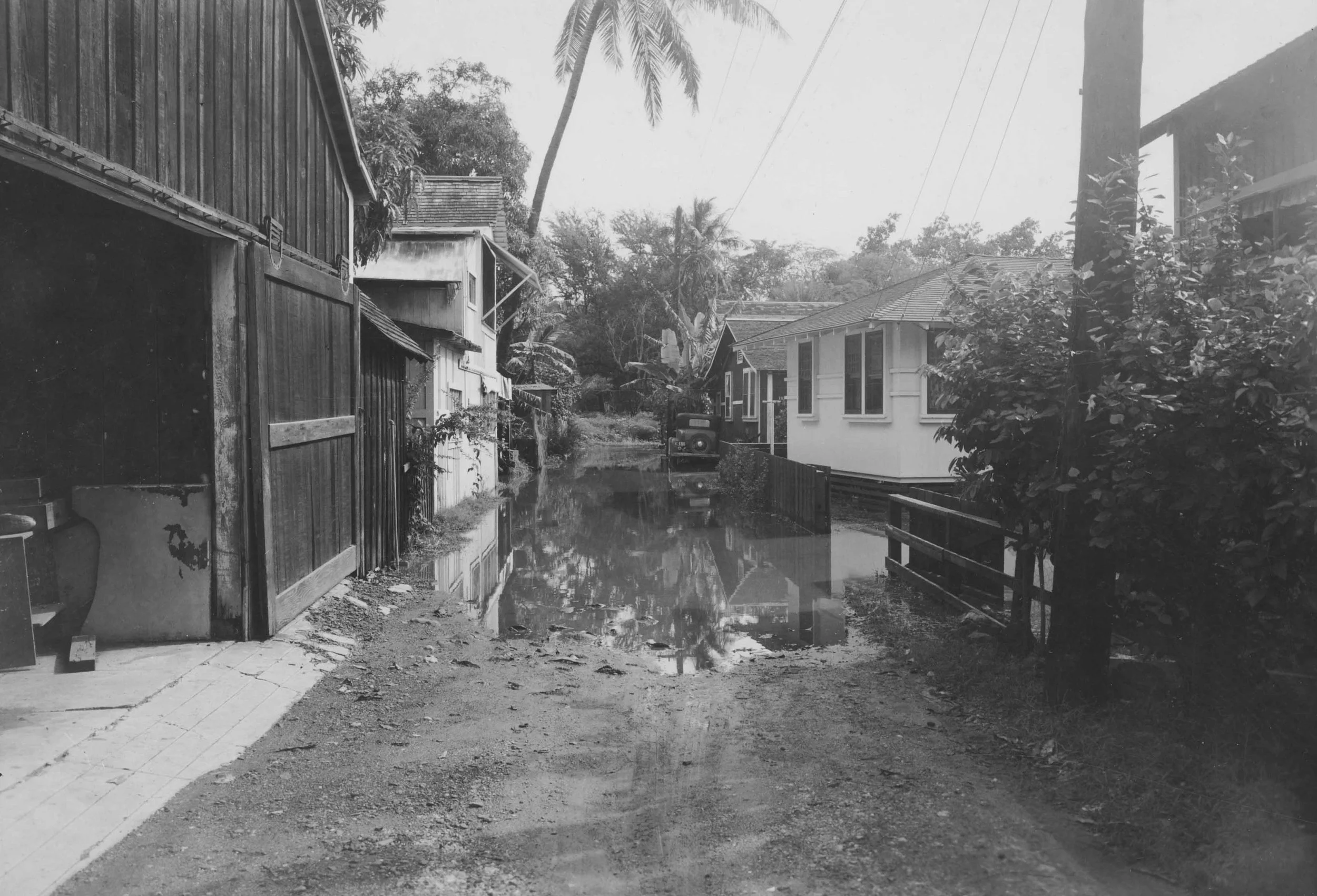
Dudoit Lane was an unpaved driveway that accessed the rental homes on Helen's property on the right, and the backs of various other owners' land and garages on the left. Here's how it looked after heavy rain on January 5, 1943. (Bishop Museum)
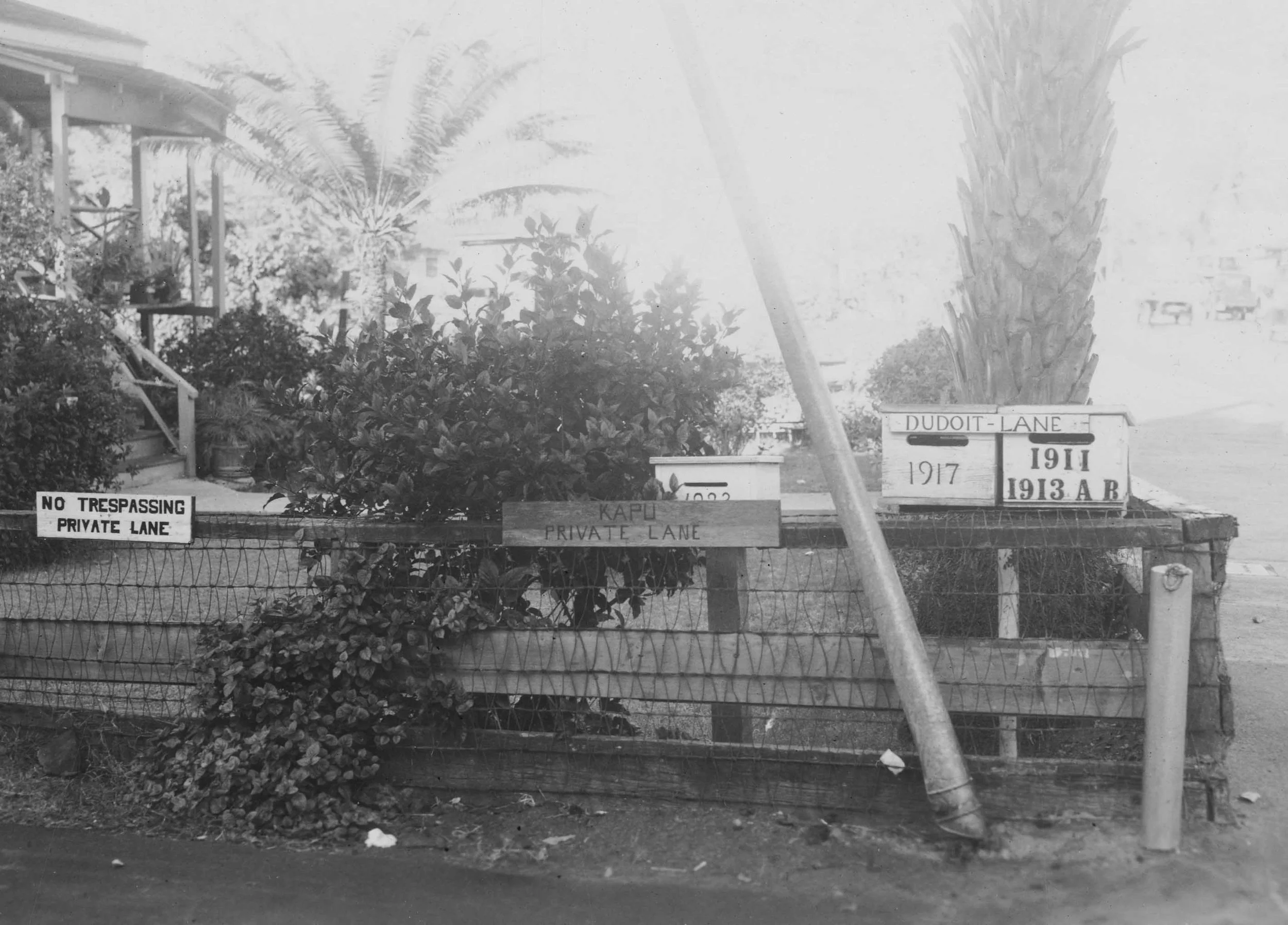
After Helen began aggressively asserting that she owned Dudoit Lane in 1948, the legal disputes and physical altercations continued for years into the 1950s. This view from June 2, 1952 shows the signs claiming private ownership and the mailboxes of Helen's rental houses on the wire fence bordering her home's front yard. Ena Road is on the right (Bishop Museum)
After Helen chained Dudoit Lane shut, this led to a legal case, and the arguments over the situation sometimes got physical:
…]Helen] used her usual bullying, arrogant tactics. (1948)
…[Helen] shoved me and attempted to slap me. Did everything possible to provoke me into striking her, which I did not. (1951)
This made Helen furious, and she took after me with a stick and tried to beat me…Helen loves to fight, and Alice appears to love to have something to worry about. (1952)
About this time Helen appeared and began to rant around. Kept threatening me with personal violence…She then chased me into the street…[a separate fight with a neighbor] resulted in the police arresting Helen herself. (1952)
We do not speak, and the case of the alley is still in court. (1956)
Reconciliation
This intense but localized battle would soon be ended by the greatly increasing pace of Waikīkī’s development and urbanization of the 1960s. This was when Waikīkī transitioned to a district of multiple highrise apartment and hotel towers. Helen and Alice moved out of the historic Dudoit family home in 1961, which was demolished four years later, and Baker himself relocated to suburban Kaimuki. Remarkably, leaving the scene of conflict mellowed everyone, and Baker and the two women became friendly again.
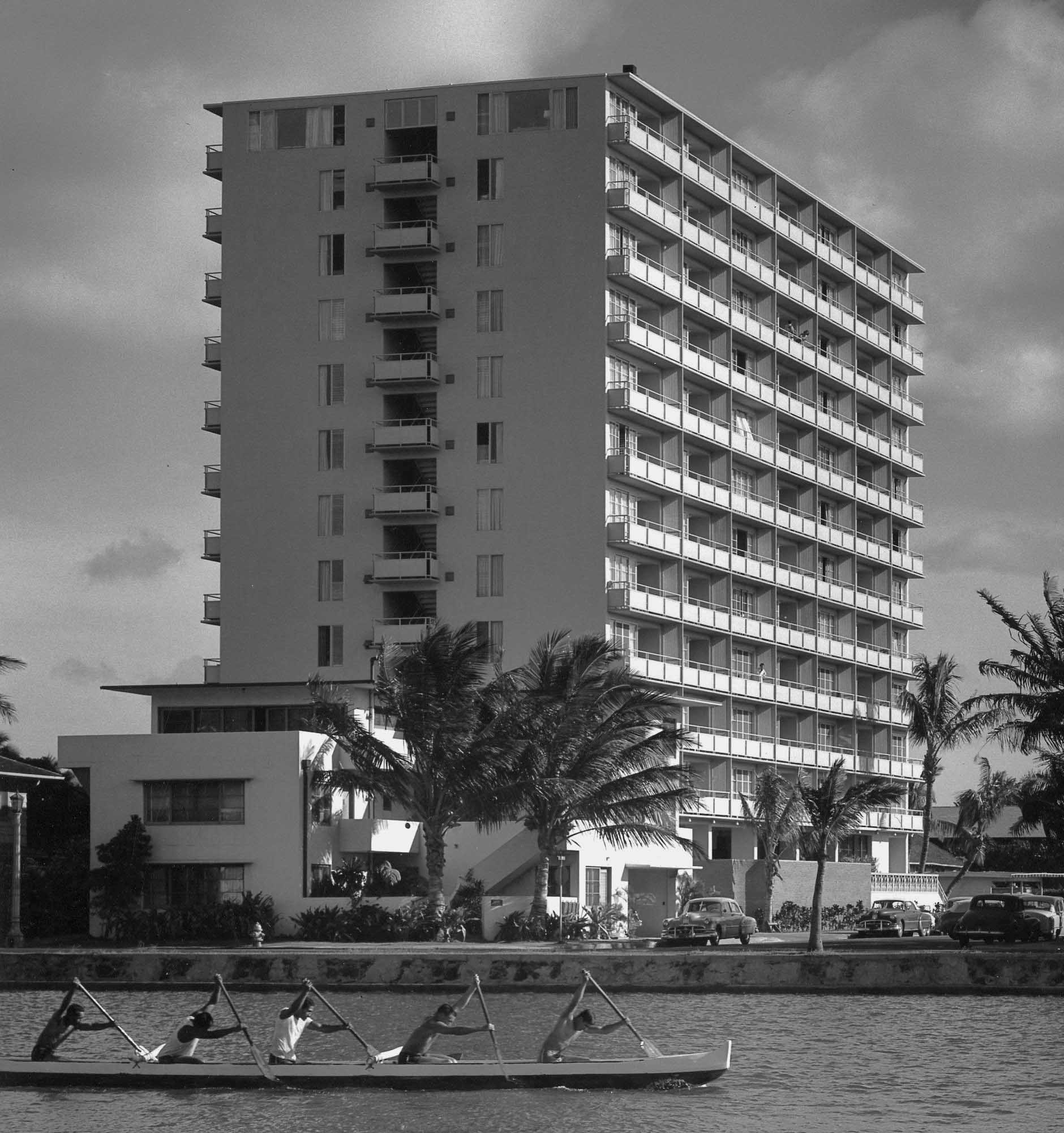
The Rosalei at 445 Kaiolu Street is notable as Waikīkī's first highrise apartment building, opened in 1955. Here it's seen with the Ala Wai Canal in the foreground. This is where Alice and Helen moved after they left the latter's family home on Ena Road in 1961 as Waikīkī's development boom began. (DeSoto Brown Collection)
Helen and Alice had moved to the Rosalei, Waikīkī’s first multi-story apartment building that had opened in 1955. In March 1962, the women invited Baker to dinner. He wrote:
In the Rosalei building, the tenants own their own apartments…When night came on the view was very nice. There was a balcony from which they could look off toward Kaimuki. Alice cooked a nice dinner…After dinner Alice told me of her eye operation…Told how lonely they were without friendly neighbors. Missed her cat since they are not allowed in the building. They both kissed me when I left…Wanted me to come again soon.
In January 1963 came another sociable meal:
…called on my former neighbors…They now live at 400 Olohana [a different building]. Neither have been well…[Helen] told me she is now 62. Still likes her beer, and had a bottle while having lunch which Alice prepared for the three of us…Both seemed greatly pleased that I called to see them.
On this warm note we end this story. Helen, Alice and Ray Jerome Baker are now all long deceased. We’re fortunate that circumstances led to the documentation of their lives, for our insight today.
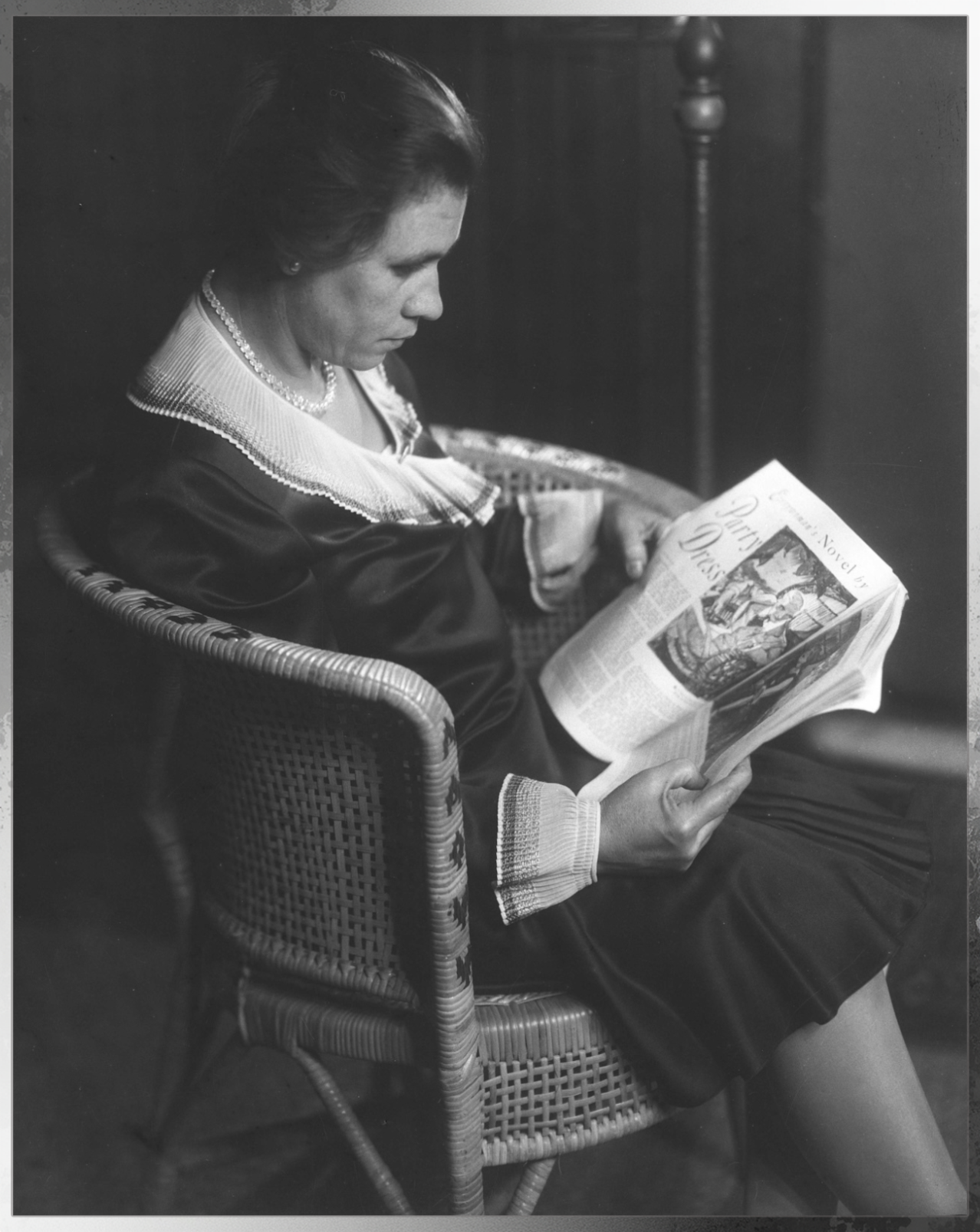
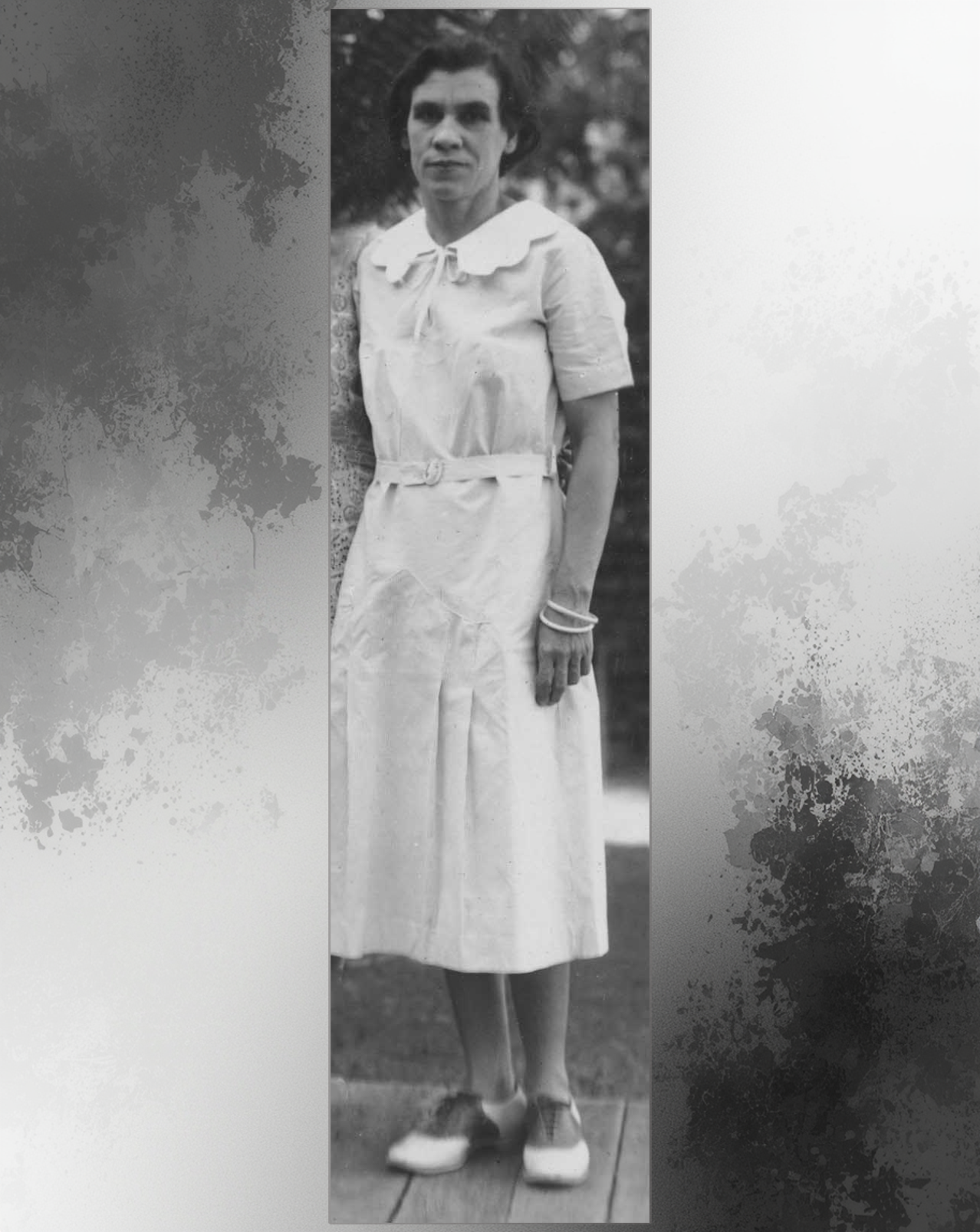
These pictures of Alice Perry in the 1930s show why a viewer today might wonder if she was transgender, assigned male at birth. Not enough information exists now to make this determination so many years later. (Bishop Museum)
One Last Question
A look at Alice in these photos brings up a question: based on her appearance, she appears unmistakably masculine. Her facial features, her shoulders and neck, her arms and even her feet could make an observer assume her to be biologically male. Could Alice have been transgender?
Probably not. To begin with, Baker knew and interacted with Alice for decades and never mentioned anything about this in his diaries. Second, multiple newspaper obituaries from 1940 onwards mention Alice Perry as the surviving daughter of Frank Perry DeMello and Mary Perry DeMello, both born in Portugal, as well as the sibling of Manuel, Joseph, Mary, Rose, Frances, Irene, and Anna. Finally, an obituary from 1983 states that Shandry Alice Perry died July 9 at the age of 89; two of the aforementioned sisters survived her. If this is, in fact, the same person, it would mean that her family had accepted her female persona and name from much earlier in her life. While not impossible, this would seem unlikely for that time period – but of course this would only be true if these newspaper articles were actually about this Alice Perry, which cannot be confirmed. If they are not, and she legally still carried a male birth name, her history might be impossible to trace today.
But it’s important to remember that treatments that enable physical transitions were not available during most of Alice’s life. Hormones and surgery, commonly used today for individuals to become the gender they truly are, were nonexistent in most places till the 1960s. Lacking these, Alice would have faced a constant battle with facial hair, for just one example, and even with daily shaving this growth would have been noticeable and even unsettling by the standards of her time to anyone who met her. This makes it unlikely that Alice was biologically male during a less accepting and aware period in history.
Still, we can wonder, even if we can never be able to know with certainty.
Citations:
Polk's Honolulu and Island of Oahu Directory, 1916 - 1961-'62
Bishop Museum Archives
Ray Jerome Baker photographs, Photo Collection
MS Group 16, Ray Jerome Baker Papers, Manuscript Collection
Newspaper Articles
"Waikiki landmark to be torn down" - Honolulu Star-Bulletin; June 24, 1965
Newspaper Obituaries
Thomas Richardson Clark - Honolulu Advertiser; Dec. 22, 1962
Wilford K. Richardson - Honolulu Star-Bulletin; Feb. 1, 1968
Frank Perry DeMello - Honolulu Advertiser; March 12, 1940
Mrs. Mary Perry DeMello - Honolulu Star-Bulletin; Sept. 11, 1950
Mrs. Mary Perry Vierra - Honolulu Star-Bulletin; July 18, 1955
Irene Perry - Honolulu Star-Bulletin; July 12, 1956
Mrs. Frances Perry DeSilva - Honolulu Star-Bulletin; Sept. 26, 1970
Joseph Perry - Honolulu Star-Bulletin; Dec. 7, 1982
Shandry Alice Perry - Honolulu Advertiser; July 13, 1983