

THE HEALER STONES OF KAPAEMAHU
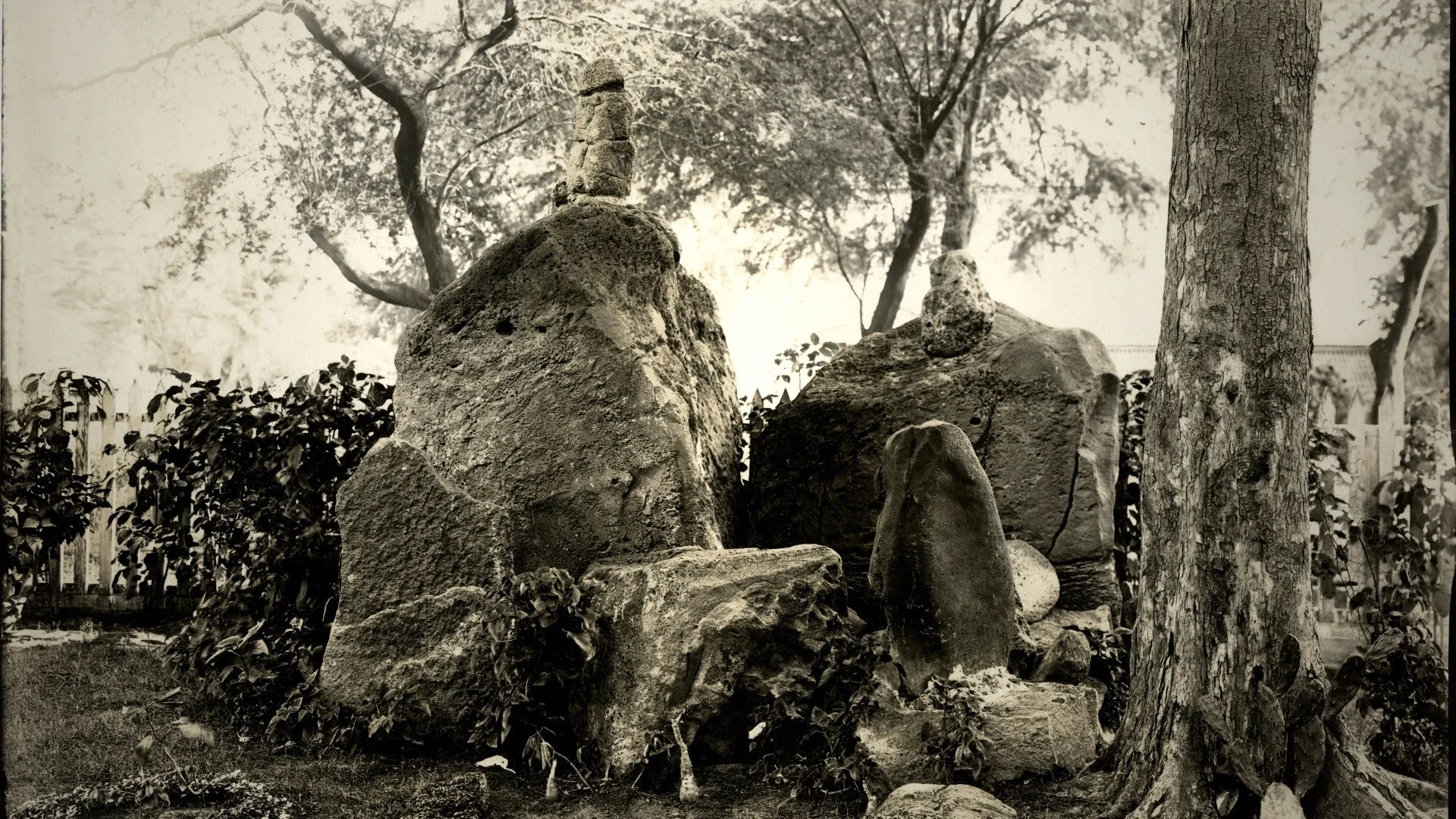
On Honolulu's famed Waikīkī Beach stand four giant boulders placed as a tribute to the four legendary māhū – individuals of dual male and female spirit - who brought the healing arts from Tahiti to Hawaiʻi long ago. Although the stones have survived for centuries, their story has been hidden and the respected role of māhū erased.
The original moʻolelo – a story that bridges the gap between history and legend - was passed down orally through generations of noble families of Waikīkī. In 1907, it was printed, for the first time, in English in the Hawaiian Almanac as conveyed to publisher Thomas Thrum by James Aalapuna Harbottle Boyd, a colonel of the Hawaiian Kingdom and confidante of Queen Liliʻuokalani.
Here then is the moʻolelo, followed by the story of its suppression, and reclamation, including at the monument intended to honor the healers’ legacy, The Healer Stones of Kapaemahu.
THE MOOLELO OF KA POHAKU KAHUNA KAPAEMAHU
Long before the reign of King Kakuhihewa in the 1500s, four Tahitian healers traveled to Hawaii from their home Moaulanuiakea on the island of Raiatea. Their names were Kapaemahu, who was the leader of the group, Kapuni, Kinohi and Kahaloa. They settled in Waikīkī in a place near here called Ulukou

The healers were māhū – extraordinary individuals of dual male and female mind, heart and spirit. They were beloved by the people for their gentle ways, and their fame spread as they traveled throughout the islands administering their miraculous cures.

When it was time to depart, they asked that two stones be placed at their residence and two at their bathing place in the sea as a permanent reminder of the relief of pain and suffering from their ministrations. Four huge stones were quarried from the vicinity of the bell rock in Kaimuki, and transported to Waikīkī on the night of Kāne.

The healers transferred their names and spiritual power to the stones, placing māhū idols under each one. Tradition states that the incantations, fasting and prayers lasted a full cycle of the moon. Then the healers vanished and were seen no more.

THE HISTORY OF THE STONES
FROM RESPECT TO NEGLECT TO RECLAMATION
After the healers left Hawaiʻi, the stones remained in Waikīkī for centuries and were revered by Hawaiian nobility.
One of the stones was partially exposed on the beachfront property of Princess Likelike and her daughter Kaʻiulani, the sister and niece of Queen Liliʻuokalani, who prayed and placed seaweed lei on them before bathing in the sea.
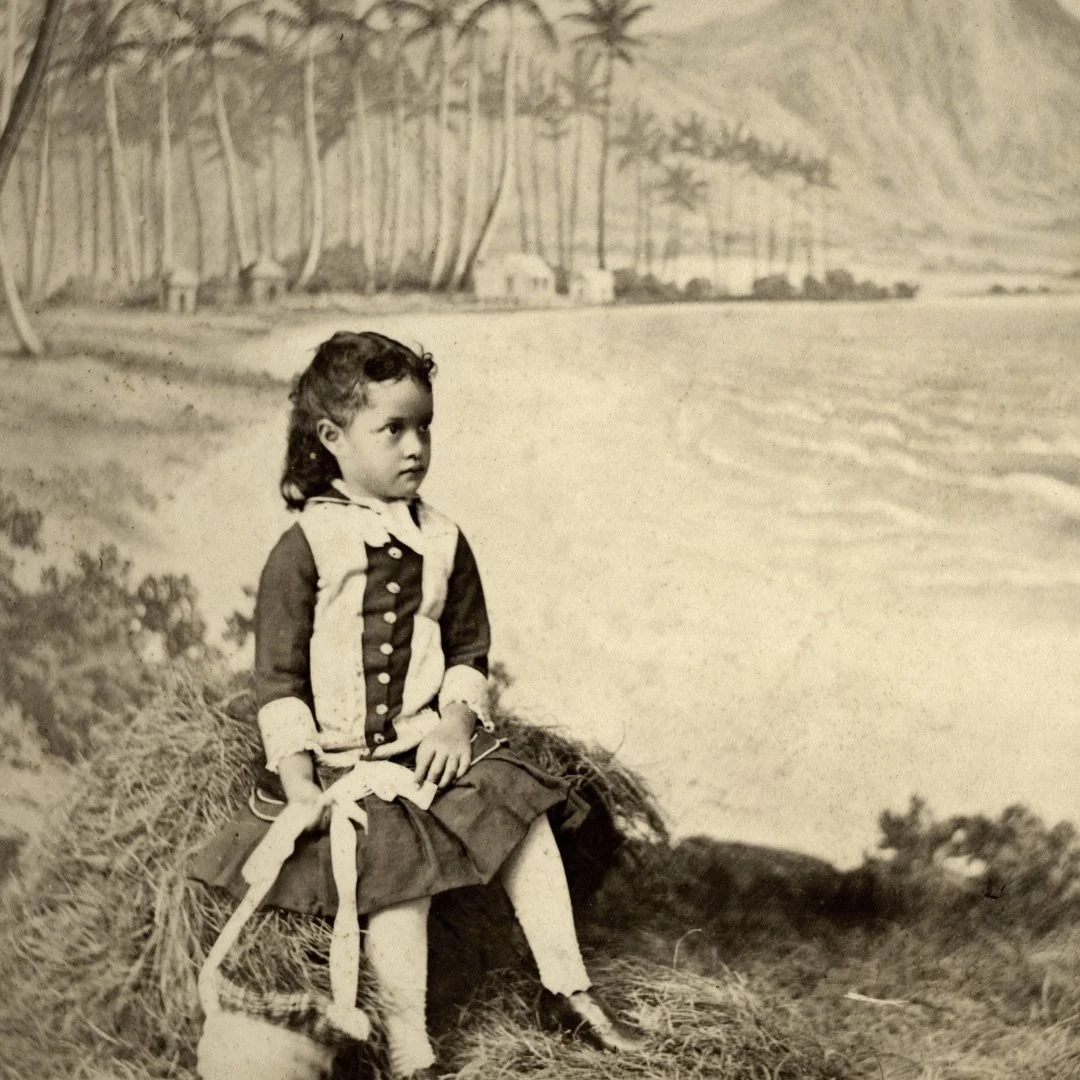
Princess Kaʻiulani at Waikīkī, ca. 1880 - (Hawaiʻi State Archives)
Their devotion led Likelike’s husband, Governor Archibald Scott Cleghorn, to excavate the four stones in 1905, and his son-in-law, James Aalapuna Harbottle Boyd, to convey their story to the publisher of the Hawaiian Almanac.
The Hawaiian title for the story was Ka Pohaku Kahuna Kapaemahu, or The Healer Stones of Kapaemahu.
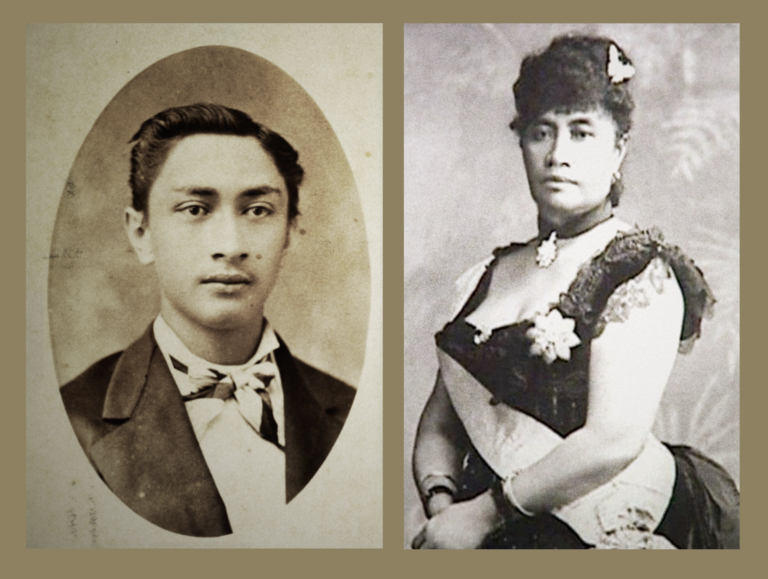
Harbottle Boyd and Queen Liliʻuokalani ca. 1880 - (Hawaiʻi State Archives)
But colonization and the introduction of foreign religion led to neglect of the stones, and disrespect for māhū, and in 1941 the stones were buried under a bowling alley built as entertainment for increasing numbers of U.S. servicemen based in the islands.
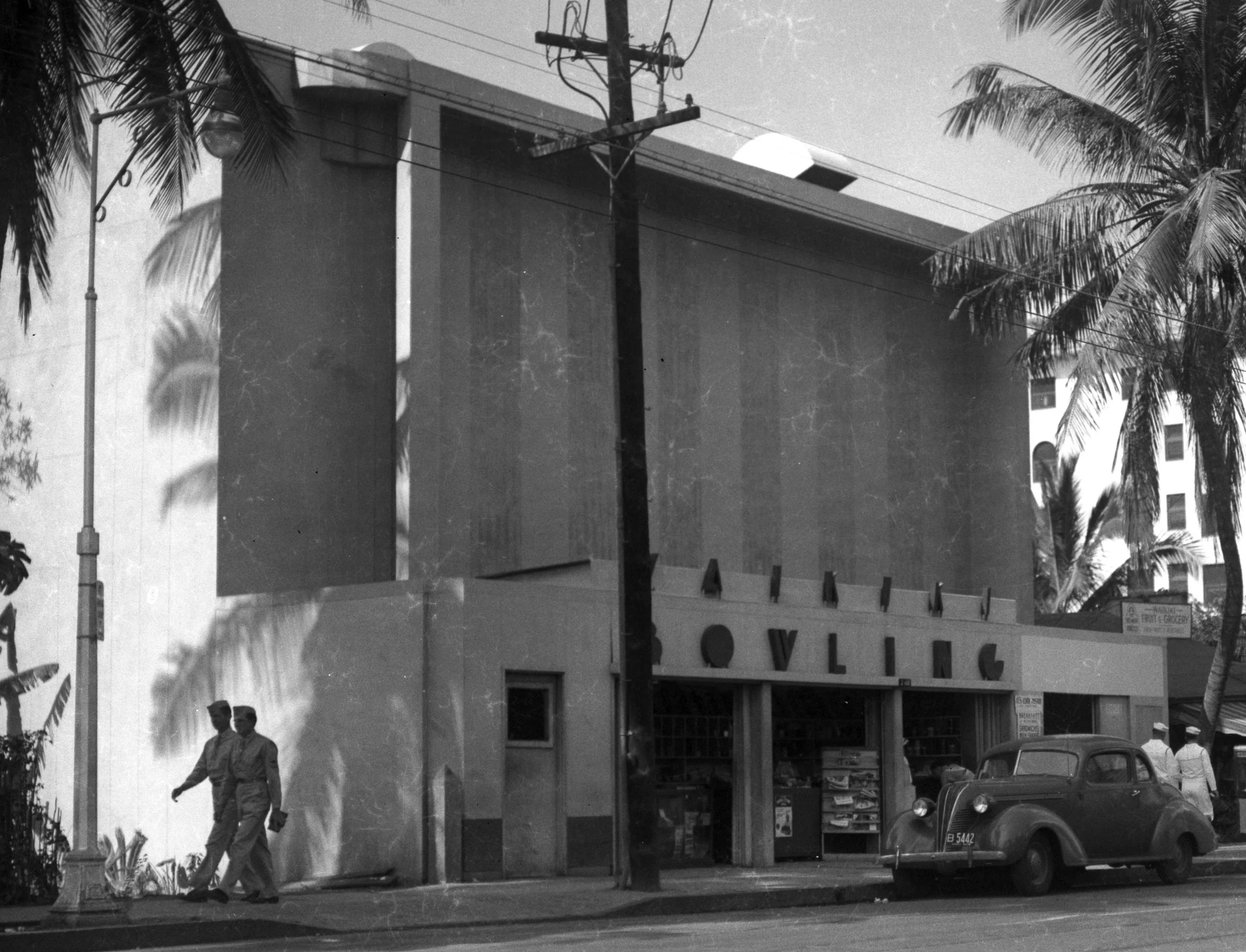
Waikīkī Bowling ca. 1950 - (DeSoto Brown Collection)
The stones were recovered in 1963 when the bowling alley was torn down as part of redevelopment efforts to open up public waterfront space in Waikīkī. Fortunately, preeminent Hawaiian authority Mary Kawena Pukui knew the story of the stones, which she defined as “a row of mahu,” and insisted they be preserved. Pukui believed that the māhū healers were “respected men; talented priests of healing and of the hula. Whether this is history or legend, it reflects attitudes of approval and admiration.”
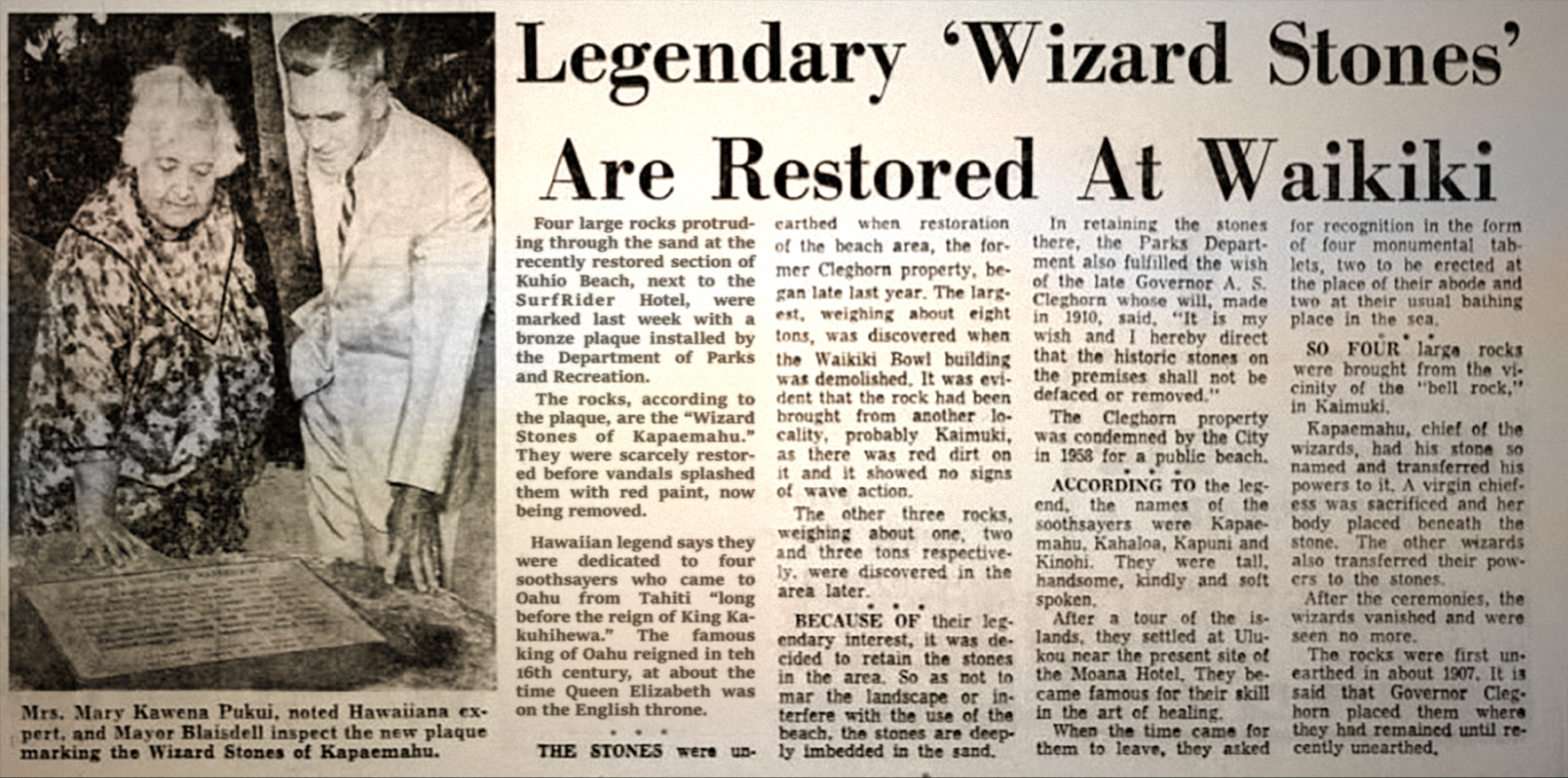
Honolulu Advertiser, September 8, 1963
Unfortunately, this was a period of great discrimination in which māhū nightclub performers had to wear a button proclaiming their biological sex to avoid arrest under Act 175, a law that made it illegal to crossdress with “the intent to deceive.”
Not surprisingly, the connection of the stones to gender fluidity was suppressed, and the role of māhū hidden. One self-proclaimed clairvoyant known as the “Lady in Red” even claimed the healers were ordinary men and women, while a tourist promoter mistranslated Kapaemahu as “not homosexual.”
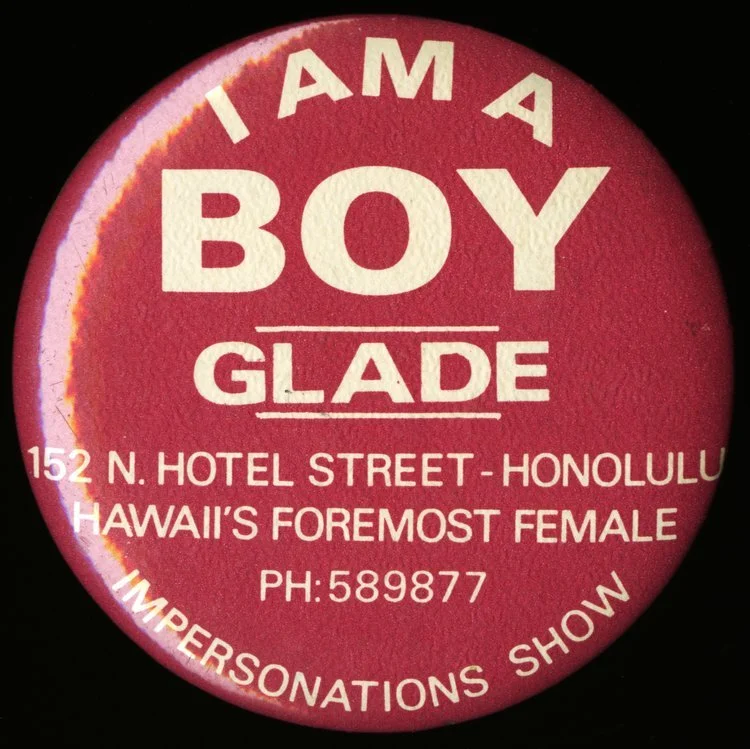
(DeSoto Brown Collection)
In an an effort to restore Hawaiianness to Waikīkī, a major renovation was undertaken in 1997. Led by traditional healer Papa Henry Auwae, the stones were placed on an elevated platform and surrounded by a fence. A stone from the healers’ home in Tahiti was also placed in the enclosure.
Despite this attention, the full story of the stones and their connection to gender diversity was omitted from the accompanying informational plaque. The stones were also called by a new name, “Nā Pōhaku Ola Kapaemāhū ā Kapuni,” that does not have an historic basis and lacks the kaona of the original Hawaiian title, “Ka Pohaku Kuhuna Kapaemahu.”
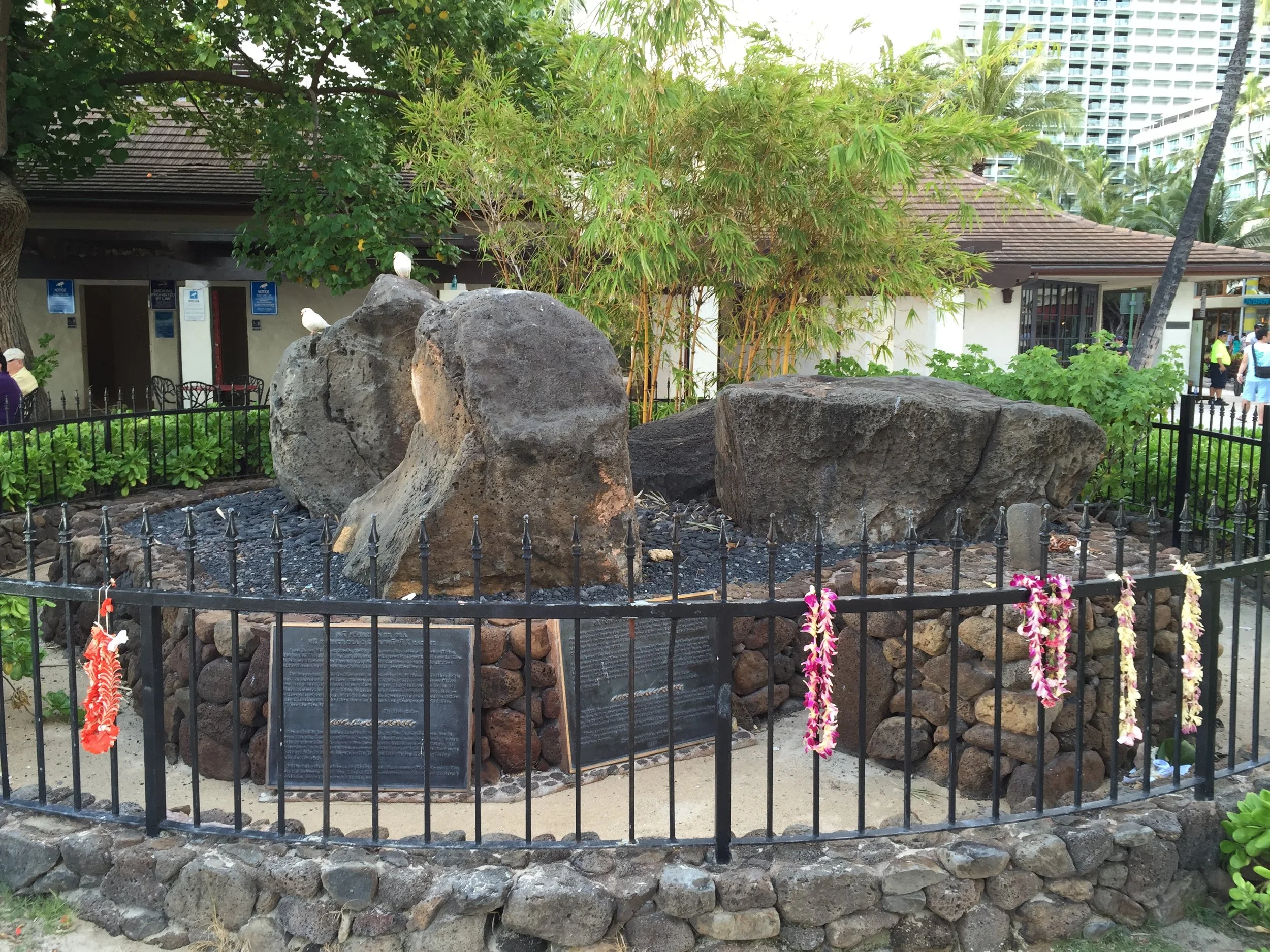
(Lei Pua ʻAla Collection)
RESTORATION AND NEW PLAQUE
Beginning a decade ago, a movement grew to restore the once-honorable status of māhū as respected members of society with important responsibilities as caretakers, healers, and keepers of ancient traditions. As part of this effort, the multimedia education and engagement collective Qwaves Kanaka Pakipika, led by Dean Hamer, Joe Wilson, and Hinaleimoana Wong-Kalu, uncovered and made known new information and understandings of the history that stimulated a community-based effort to update the signage at the Kapaemahu site. This included producing an animated short film, a children’s picture book, a documentary film, a museum exhibition, and a live hula show that introduced the story to a diversity of new publics . (See more at kapaemahu.com)
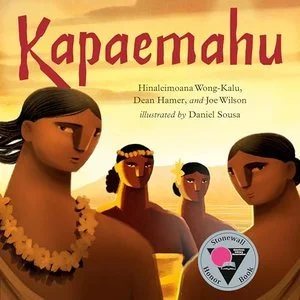
Kokila, an imprint of Penguin Random House
In 2023, a new bronze plaque was installed on a stone in front of the site to provide visitors and residents with information to help them better understand the history, stories, and current meanings of this sacred site. Now everyone who visits the Healer Stones of Kapaemahu can behold their remarkable power.
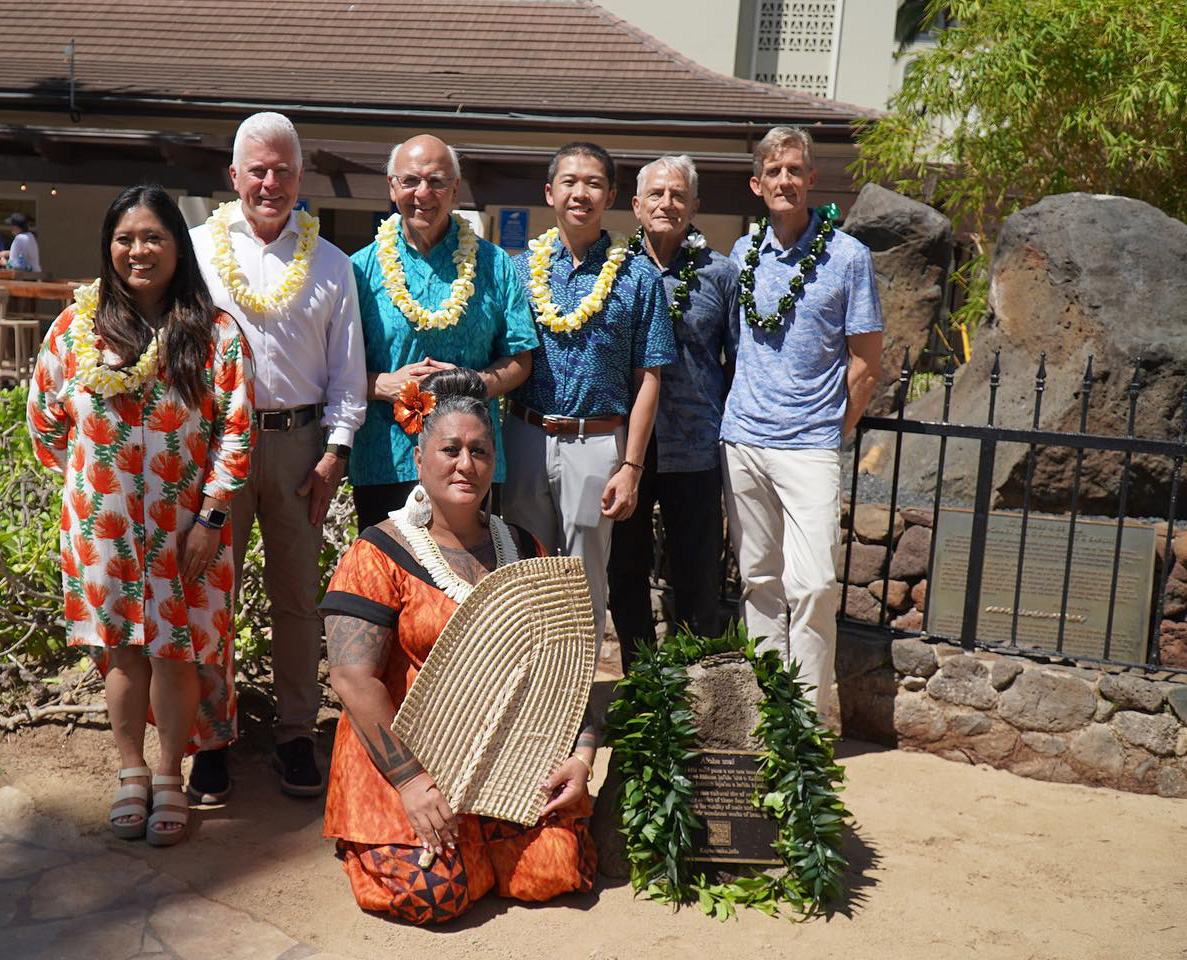
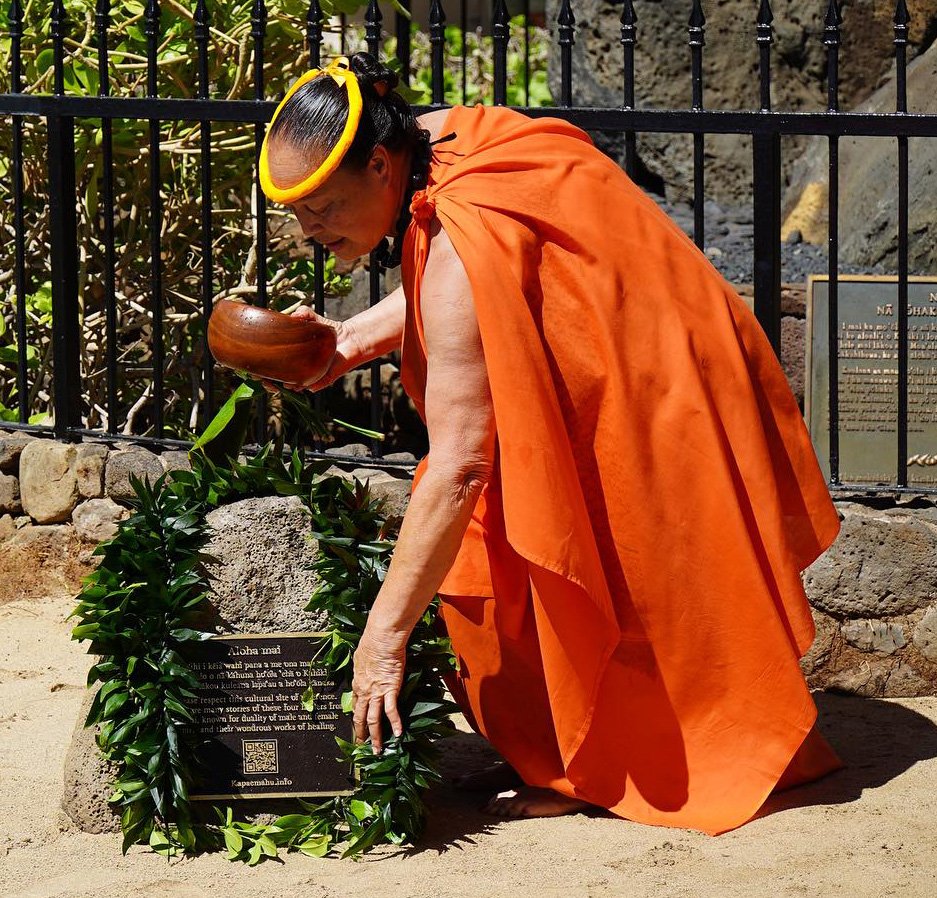
Kumu Charlani Kalama blessing the new Kapaemahu plaque.
Group, L to R, City Councilmember Radiant Cordero; Honolulu Managing Director Mike Formby and Mayor Rick Blangiardi; State Rep. Adrian Tam; Dean Hamer & Joe Wilson; kneeling, Hinaleimoana Wong-Kalu.
(Lei Pua ʻAla Collection)
Today the stones occupy a protected location in the heart of Waikīkī beach. For those who know their history and understand their meaning, they are a permanent reminder of the skills and accomplishments of the four māhū healers. You can help preserve the honor and dignity of this storied site of the Hawaiian people by sharing their story.
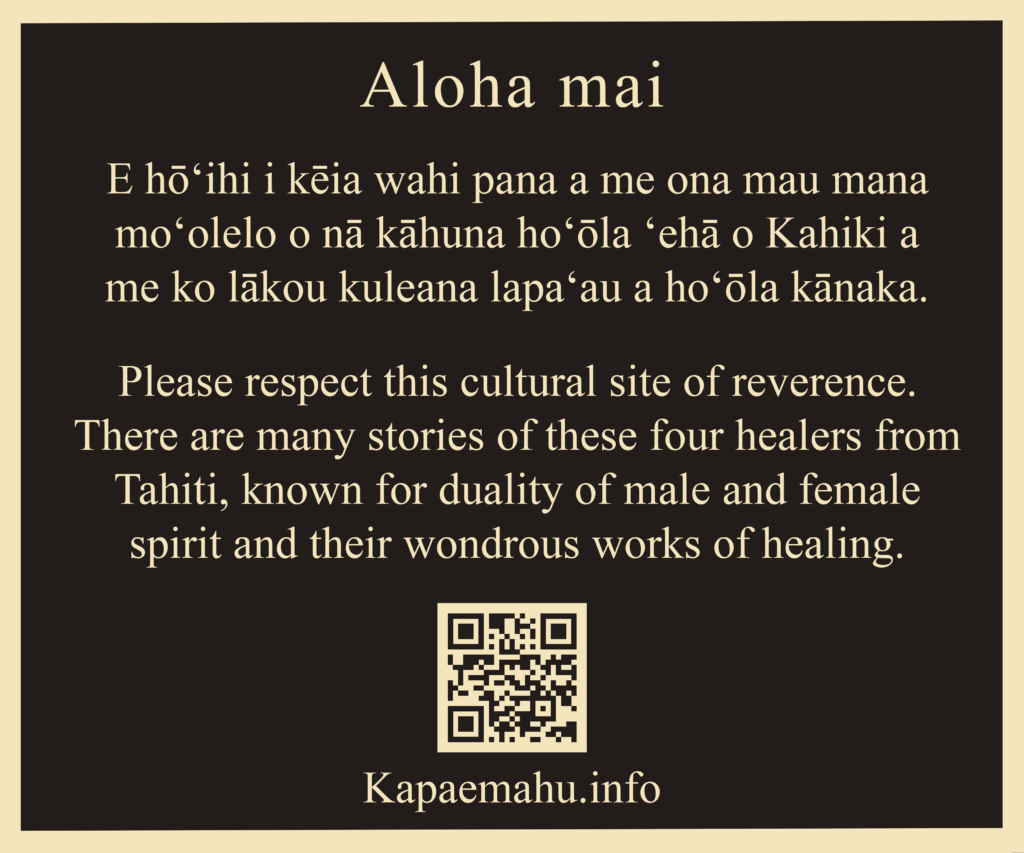
Close-up of new plaque.
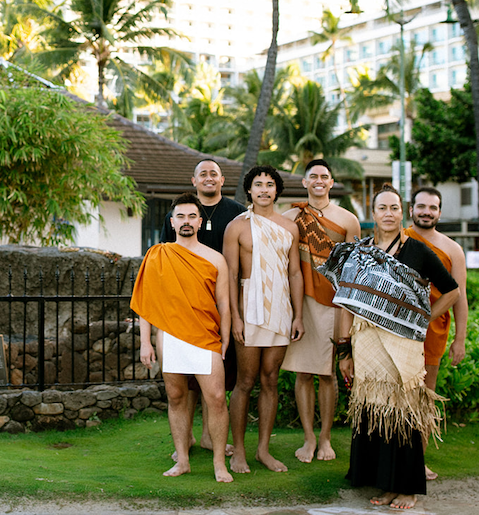
Members of the Māhūi, the Culture and Education subcommittee of the Hawai’i LGBT Legacy Foundation, which conducts an annual ceremony at the stones to kick-off Honolulu Pride. (Lei Pua ʻAla Collection)
WATCH THE ANIMATED STORY
This telling of the moolelo is based on the handwritten manuscript of a story conveyed by James Aalapuna Harbottle Boyd, a colonel of the Hawaiian Kingdom and confidante of Queen Liliʻuokalani, to Thomas Thrum, publisher of the Hawaiian Almanac. It was published in 1907 with the Hawaiian title Ka Pohaku Kahuna Kapaemahu (The Healer Stones of Kapaemahu), and the English title “Tradition of the Wizard Stones Kapaemahu.”
The animation is narrated in Olelo Kanaka Niihau, the only form of Hawaiian uninterrupted by western contact and closest to the language probably spoken by the mahu healers. This moolelo section of this page uses the simple orthography that was employed in Hawaiian language literature and newspapers prior to the introduction of the diacriticals that aide students and teachers of Hawaiian as a second language.
VIRTUAL TOUR OF BISHOP MUSEUM EXHIBITION

Curated by Dean Hamer, Joe Wilson, and Hinaleimoana Wong-Kalu in collaboration with Bishop Museum Historian and Curator for the Archives, DeSoto Brown, The Healer Stones of Kapaemahu exhibition was on display in the 7,000 sq. ft. Castle Memorial Building June 18 - October 16, 2022.
Presented in both English and ʻōlelo Niʻihau, the only form of Hawaiian unbroken by foreign contact, this exhibition marked Bishop Museum’s most comprehensive use of the Hawaiian language in an exhibit to date, signaling its commitment to centering the work in a Hawaiian worldview.