

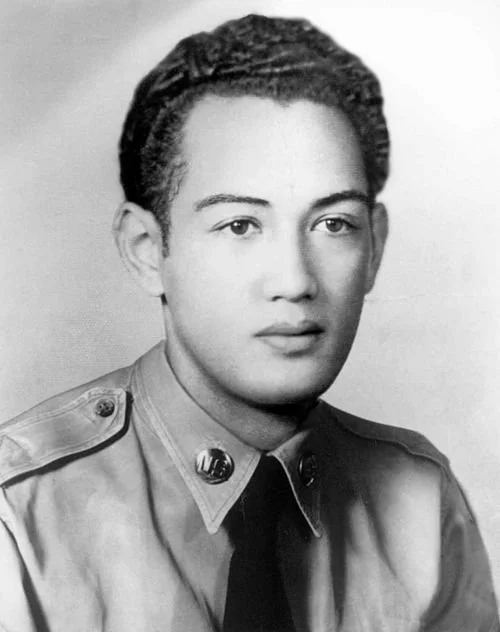
Herbert Kailieha Pililaʻau
Private First-Class Herbert Kailieha Pililaʻau was the ninth of 14 children born to Abigail Pililaʻau and “the most like her, so kind-hearted and generous,” said Mercy Garcia and Agnes Kim in a 1981 newspaper article about their Korean War hero brother.
Herbert read a lot, pounded poi with his father William in their Waiʻanae home, and could pick out opera arias on his ukulele. “He washed and ironed his clothes,” the sisters said. “He was always helping old people, carrying home their groceries, and he talked nice about everything, even Korea, how beautiful it was in spring. He was so gentle, he didn’t even know how to fight.”
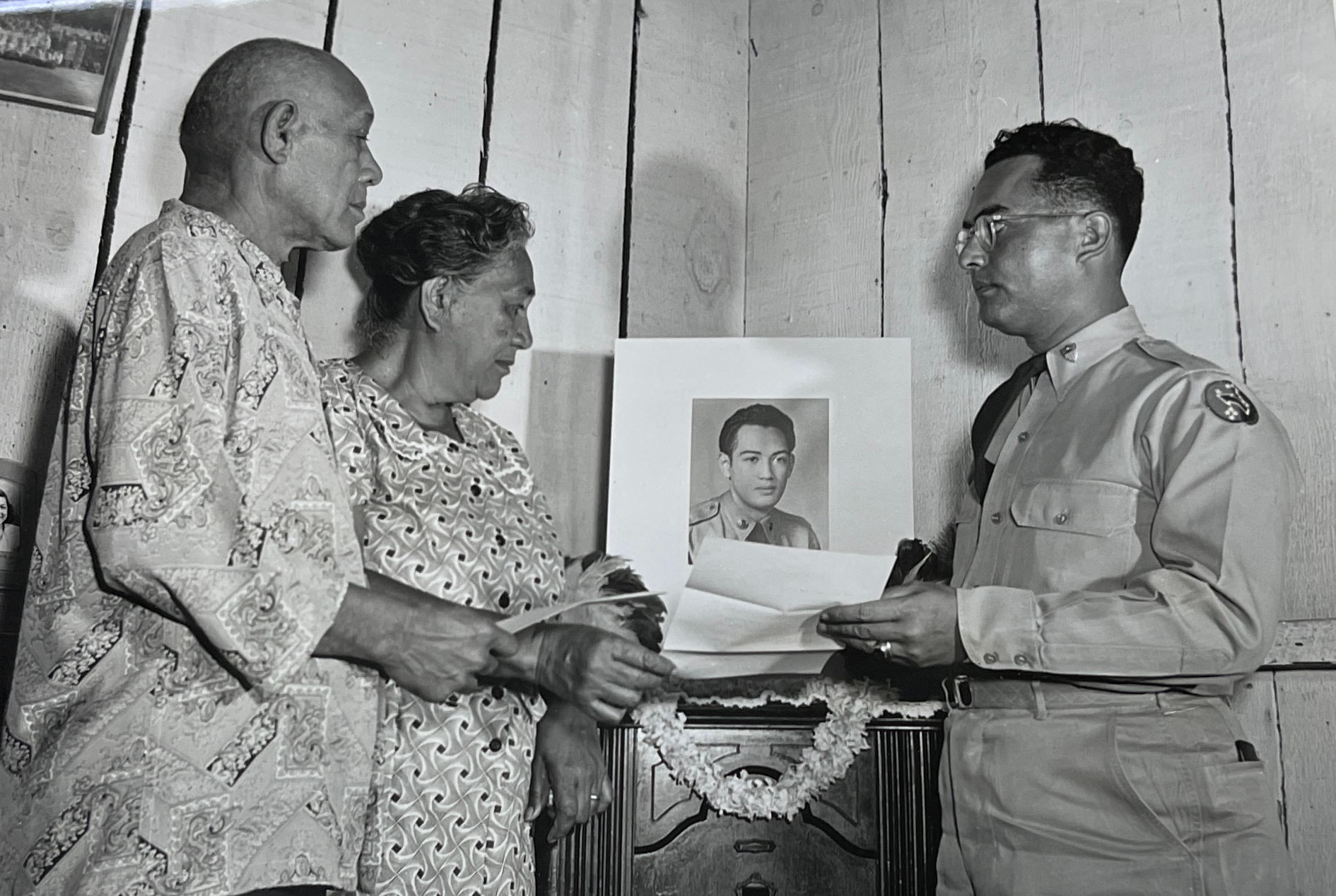
Pililaʻau Family with portrait of Herbert, Honolulu Star-Bulletin, May 21, 1952 - Hawaiʻi State Archives
After graduating from Waipahu High School in 1948, Herbert enlisted in the U.S. Army and was assigned to the 40th Infantry Division. In September 1951, during fierce fighting near Pia-ri, Korea, also known as Heartbreak Ridge, his unit came under a massive enemy assault. As Chinese forces overran American positions, Pililaʻau repeatedly exposed himself to enemy fire to protect fellow soldiers and help them withdraw to safety. Armed with grenades and rifle fire, he fought almost single-handedly against overwhelming numbers, buying critical time for others to escape.
According to military accounts, Pililaʻau refused opportunities to retreat and continued fighting alone, in hand-to-hand combat, until he was killed in action at just 22 years old. His bravery was credited with saving many lives and preventing a complete collapse of his company’s position.
In 1952, he was posthumously awarded the Congressional Medal of Honor, the first Native Hawaiian to receive the nation’s highest military decoration. At the ceremony in Washington, D.C., President Truman cited Pililaʻau for “conspicuous gallantry and outstanding courage above and beyond the call of duty” when he presented the award to the soldier’s parents.
In a newspaper report, Abigail Pilila’au said about her son, “Herbert was always a quiet boy who would rather stay home and tend to his orchids. He also preferred to listen to his collection of opera records than go dancing or fishing with his brothers.”
President Truman with Abigail and William Pililaʻau, 1952 - Hawaiʻi State Archives
Honolulu Advertiser, June 5, 1952
Back home in Hawaiʻi, the heroism of this gentle young man was lauded with a parade, and he was buried at Punchbowl, the National Memorial Cemetery of the Pacific. Schools, parks, and military facilities across Oʻahu also were dedicated in his name, including the Herbert K. Pililaau Army Recreation Center on the Waiʻanae coast. In 1998, a live-fire range at the Makua Valley military training facility was named after Pililaʻau, and in 2000 the Navy christened its newest cargo ship in honor of the courageous fighter.
Honolulu Star-Bulletin, May 17, 1953 - Hawaiʻi State Archives
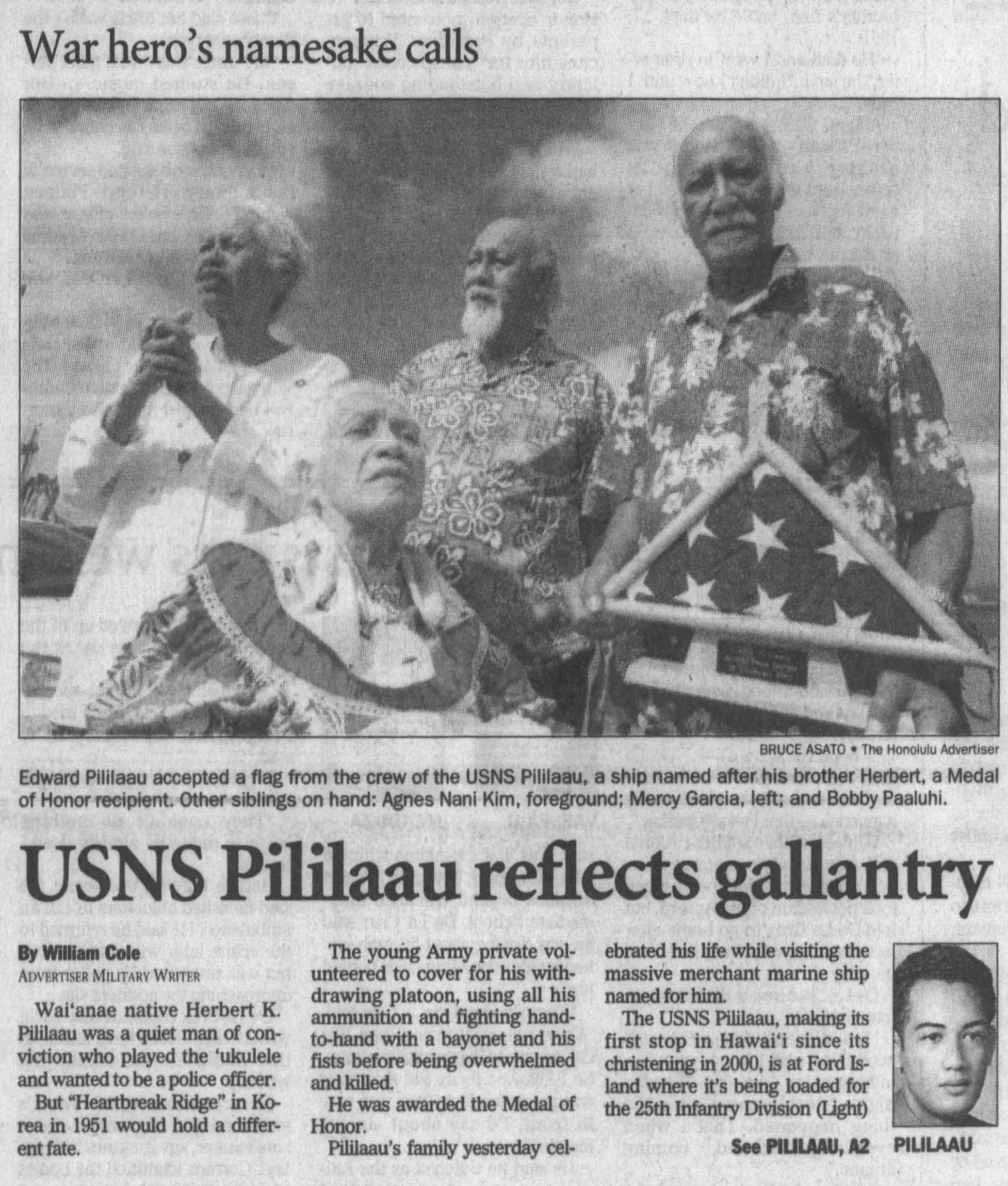
Honolulu Advertiser, December 11, 2003
Now, more than seven decades after his death, the particular ways in which Herbert was so lovingly remembered by his family prompt questions about how histories considered sensitive, including queer histories, across the ages have often been cloaked in coded language of their times, discerned by curious seekers able to read between the lines.
We will never know how Herbert Kailieha Pililaʻau’s life might have unfolded had he lived to an old age. We hope that someday the fullness of his life - a man who continues to be cherished so dearly - will come more clearly into view.
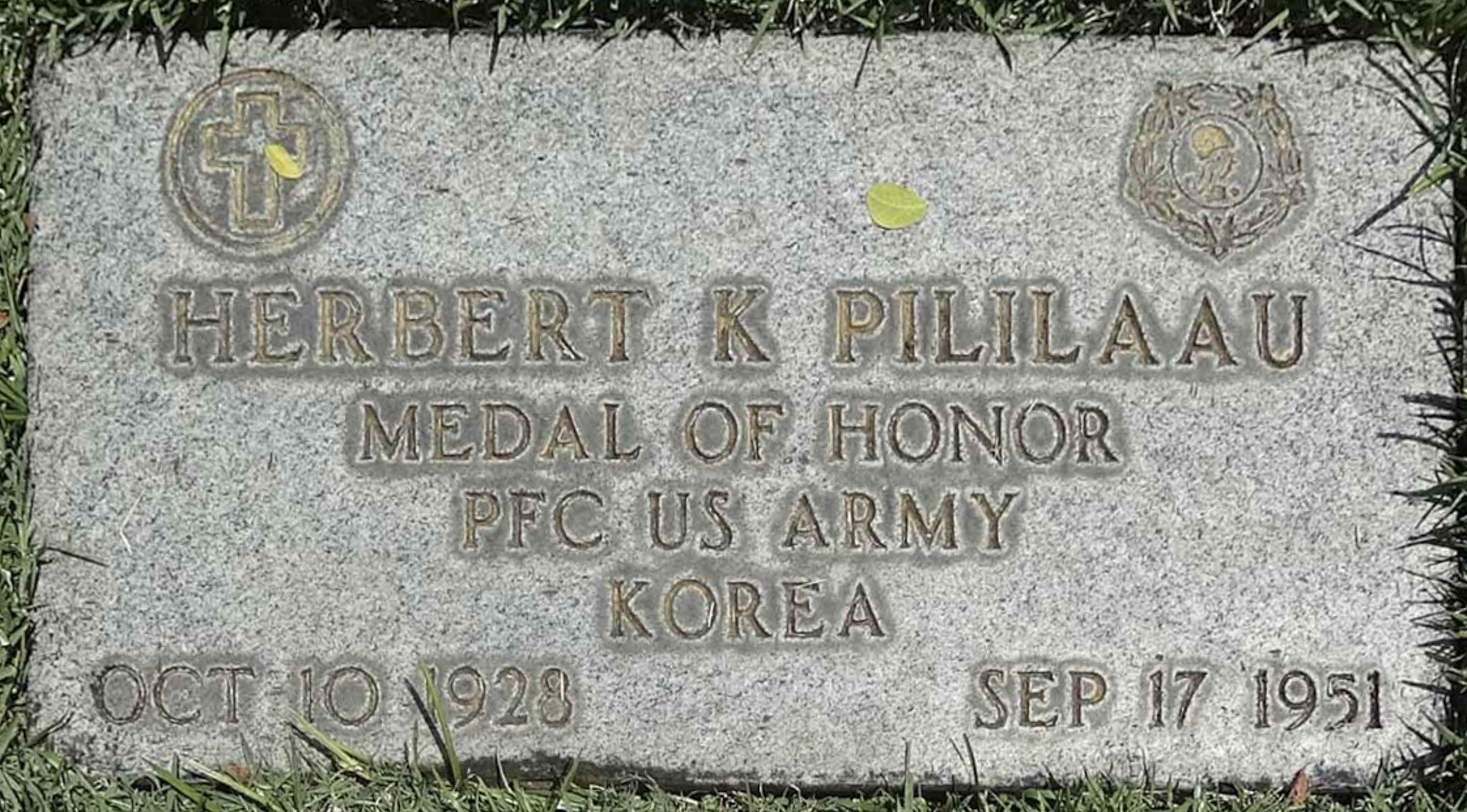
Headstone in the National Memorial Cemetery of the Pacific, Honolulu
Story by Joe Wilson
Sometimes, hidden histories are revealed in unexpected ways…
The idea for this story emerged in social media debates that erupted after an episode of the Apple+ TV series Chief of War portrayed an intimate same-sex (aikāne) relationship between two Hawaiian aliʻi, Kalanikūpule & Lima of Maui.
As the online battle raged between the usual positions of those who understand and respect Hawaiian culture’s traditional embrace of sexual fluidity and those who condemn it based on their adopted religiosity, one commenter, Calveena Kamealoha-Gomes, stated:
“In every culture through time there were 2-spirited, Mahu, gay, whatever you wanna call them, they exist. They lived past the great flood, Sodom and Gomorrah and whatever was thrown against them, they survived... ... I hope you all learn that they are people too and should be respected, and yes, they are truly part of our warrior men who fought to protect.”
Calveena continued: “Who is our modern day hero kanaka who was given a Purprle Heart for the Korean War and saved his men? And killed like 40 men so his men could get to safety and was Mahu? Herbert K. Pililaau from Waiʻanae and my uncle.”
Calveena’s comment about her Uncle Herbert was seconded by another Pililaʻau family member who said that this aspect of his life was widely known and accepted, albeit not widely discussed.
So, I went back to the historical archive to piece the fragments of Herbert’s story together in this new light.
Herbert K. Pililaʻau was the first Native Hawaiian to receive the Congressional Medal of Honor and his name adorns a city park, military facilities, even a U.S. Naval ship. He is buried in the National Cemetery of the Pacific at Punchbowl and commended in Honolulu’s Korean War Memorial.
Evident in the loving ways they remembered him in news interviews after his death, Herbert’s family accepted and admired him exactly as he was in the context of their time.
This is some of Herbert’s story. How do you see it?
For more on the Chief of War portrayal of aikāne, see the talk story on Episode 3 featuring Pa‘a Sibbett—Head Writer and Co-Creator of the Apple TV+ series Chief of War— and guests Kaina Makua and Dr. Kalehua Krug on the Kanaeokana YouTube channel (beginning at 1:05:41).
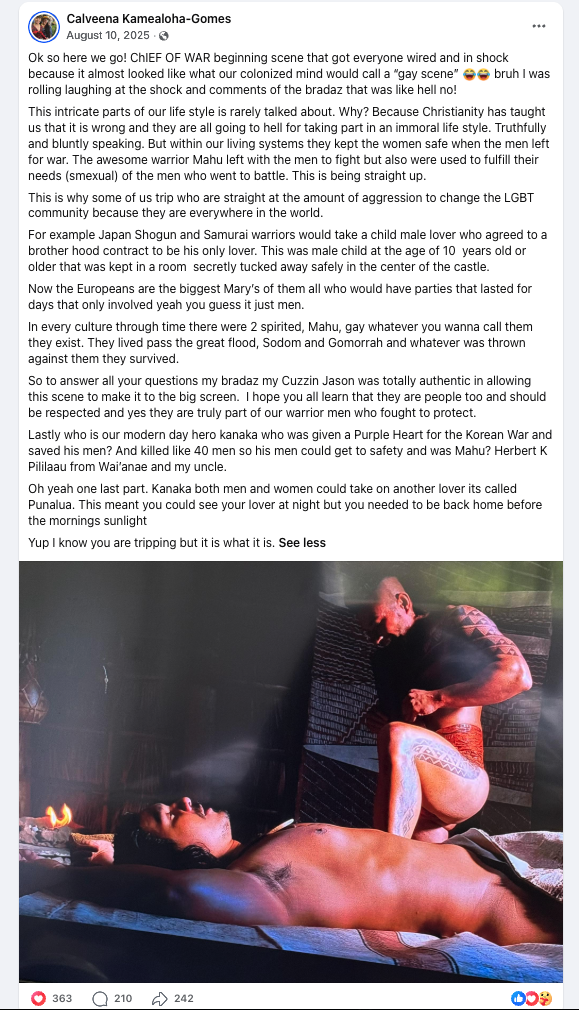
Calveena Kamealoha-Gomes, Facebook, August 10, 2025
Banner Image: Mr. and Mrs. William Pililaʻau Sr. of Waianae, left, with Lt. A.J. Ahakuelo of the adjutant general’s office - Honolulu Advertiser, May 17, 1952 - Hawaiʻi State Archives
Citations:
“Highest Military Decoration Awarded to Waianae Soldier” - Honolulu Star-Bulletin, May 17, 1952
“U.S. Highest Award to Dead Oahu Soldier” - Honolulu Advertiser, May 17, 1952
“Hero’s Parents Back With Nation’s Highest Award” - Honolulu Advertiser, June 5, 1952
“Park Named for war Hero” - Honolulu Star-Bulletin, September 10, 1953
“New Headstones Go to 3 Hawaii Heroes” - Honolulu Advertiser, May 12, 1976
“Army to Name Site After Isle Korean Hero” - Honolulu Star-Bulletin, April 5, 1989
“Waianae Remembers a War Hero” - Honolulu Star-bulletin, November 8, 1992
“Firing Range Named for Waianae Hero” - Honolulu Advertiser, May 11, 1998
“Navy Names Ship After Hero” - Honolulu Advertiser, January 10, 2000
“USNS Pililaau Reflects Gallantry” - Honolulu Advertiser, December 11, 2003
“PARC’s Namesake Provides Perfect Warrior” - Honolulu Advertiser, December 11, 2015

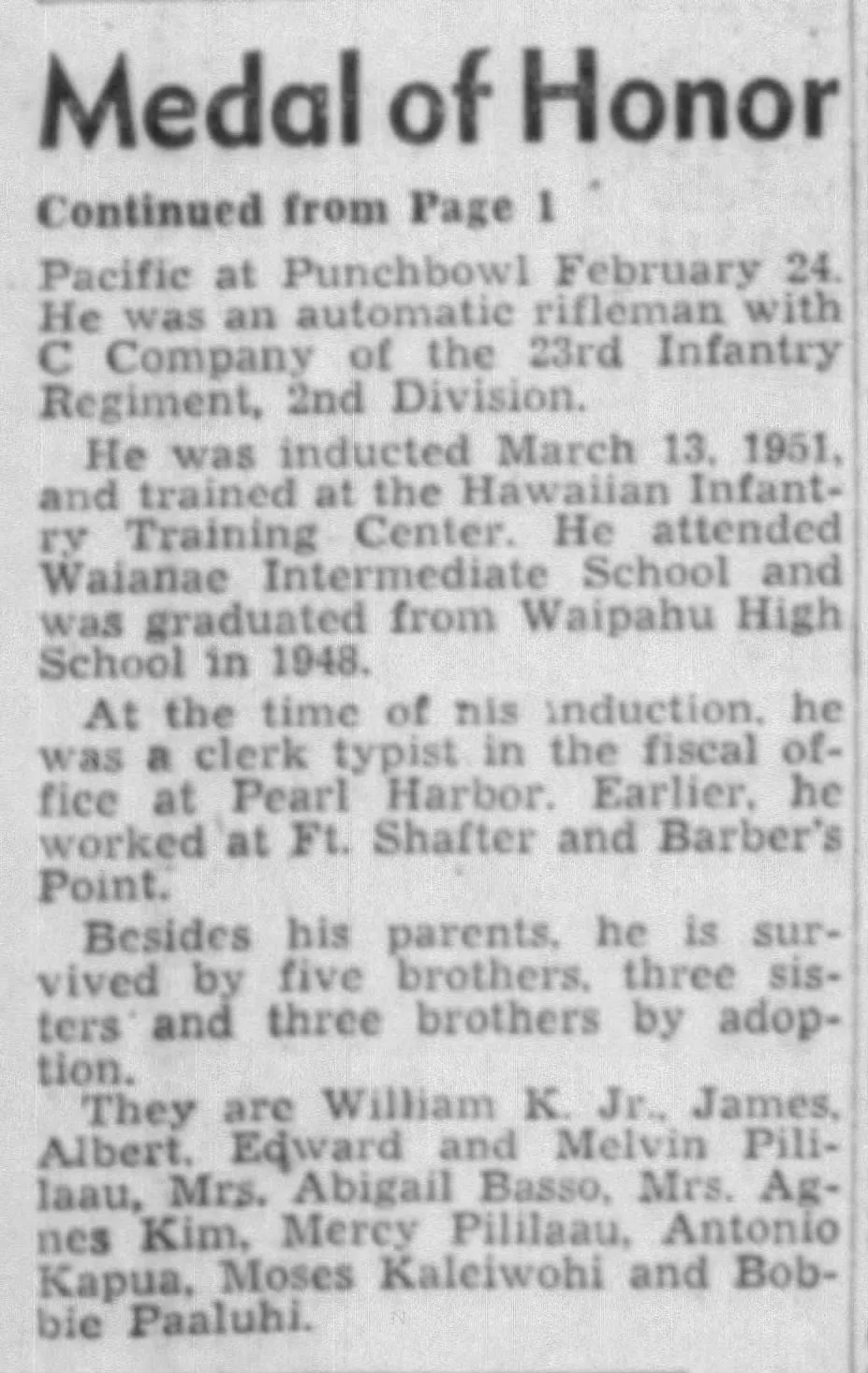
Honolulu Star-Bulletin, May 17, 1952

Honolulu Star-Bulletin, September 11, 1953

Honolulu Star-Bulletin, November 8, 1981
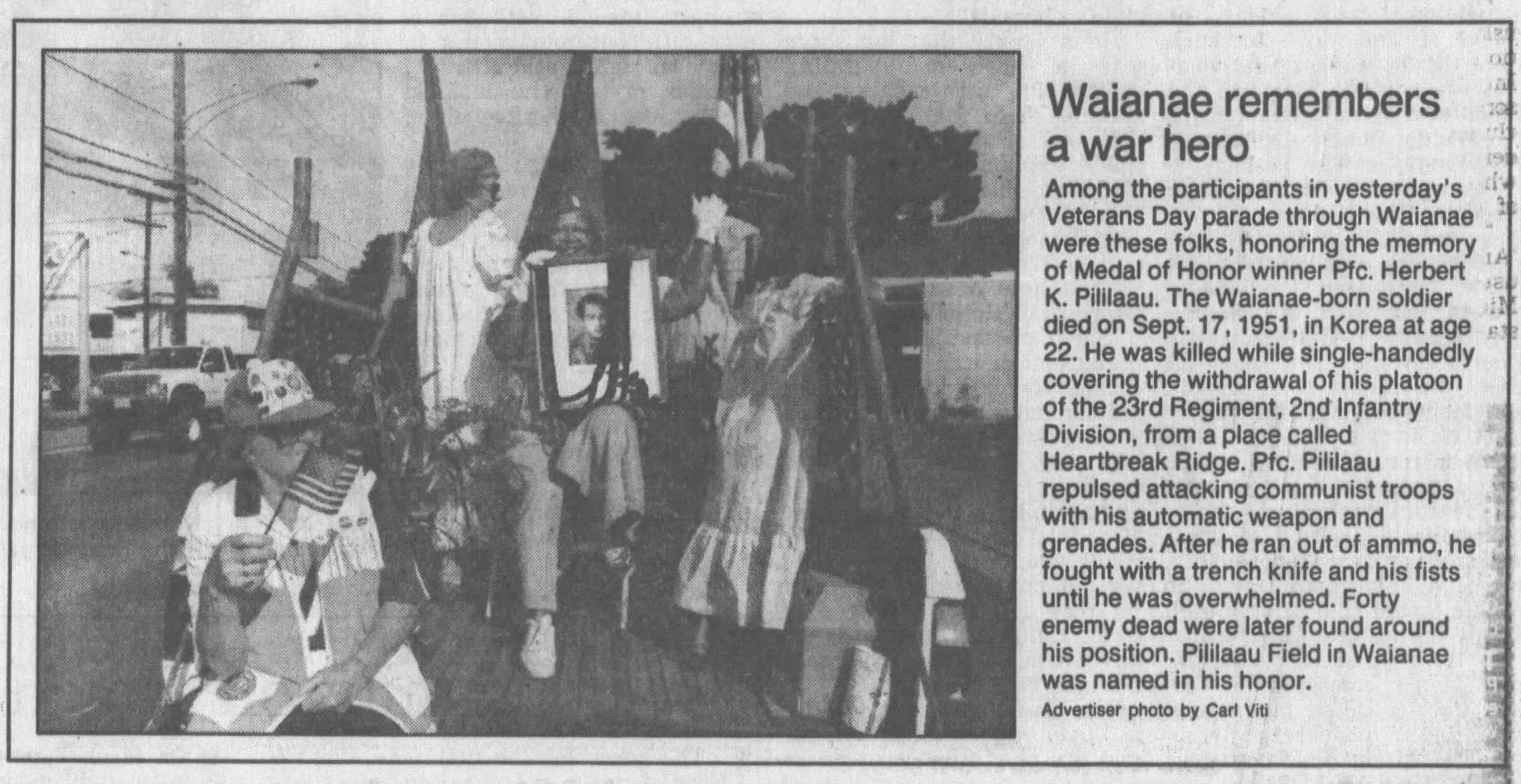
Honolulu Star-Bulletin, November 8, 1992
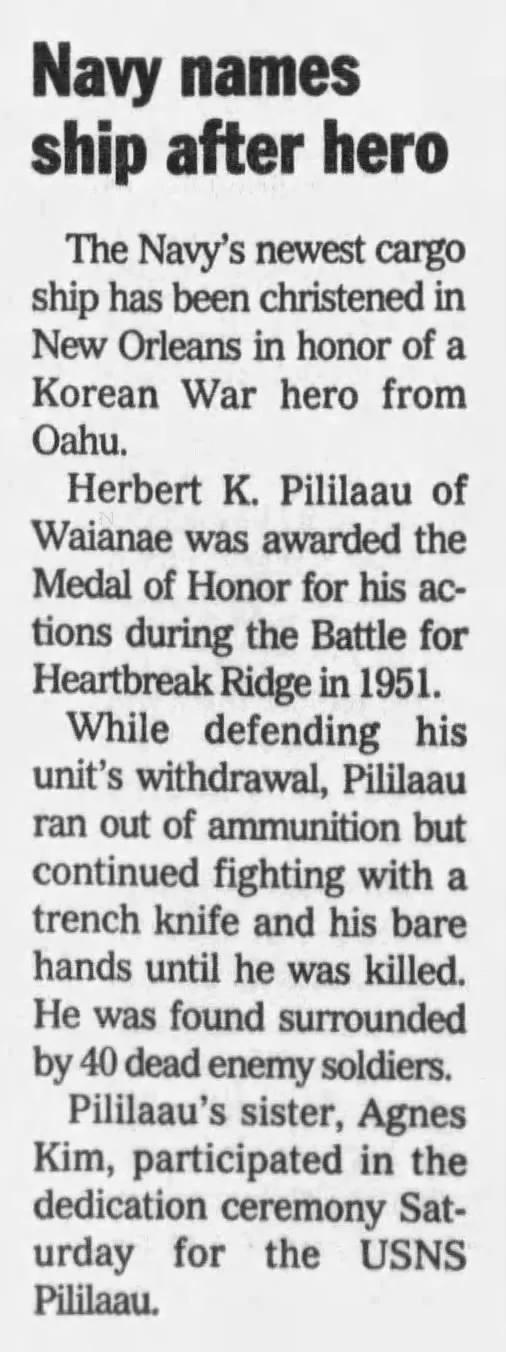
Honolulu Advertiser, January 10, 2000


Honolulu Advertiser, December 11, 2015