

The Return of Kapaemahu:
A Year of Cultural Restoration in Waikīkī
by Sarah Burke
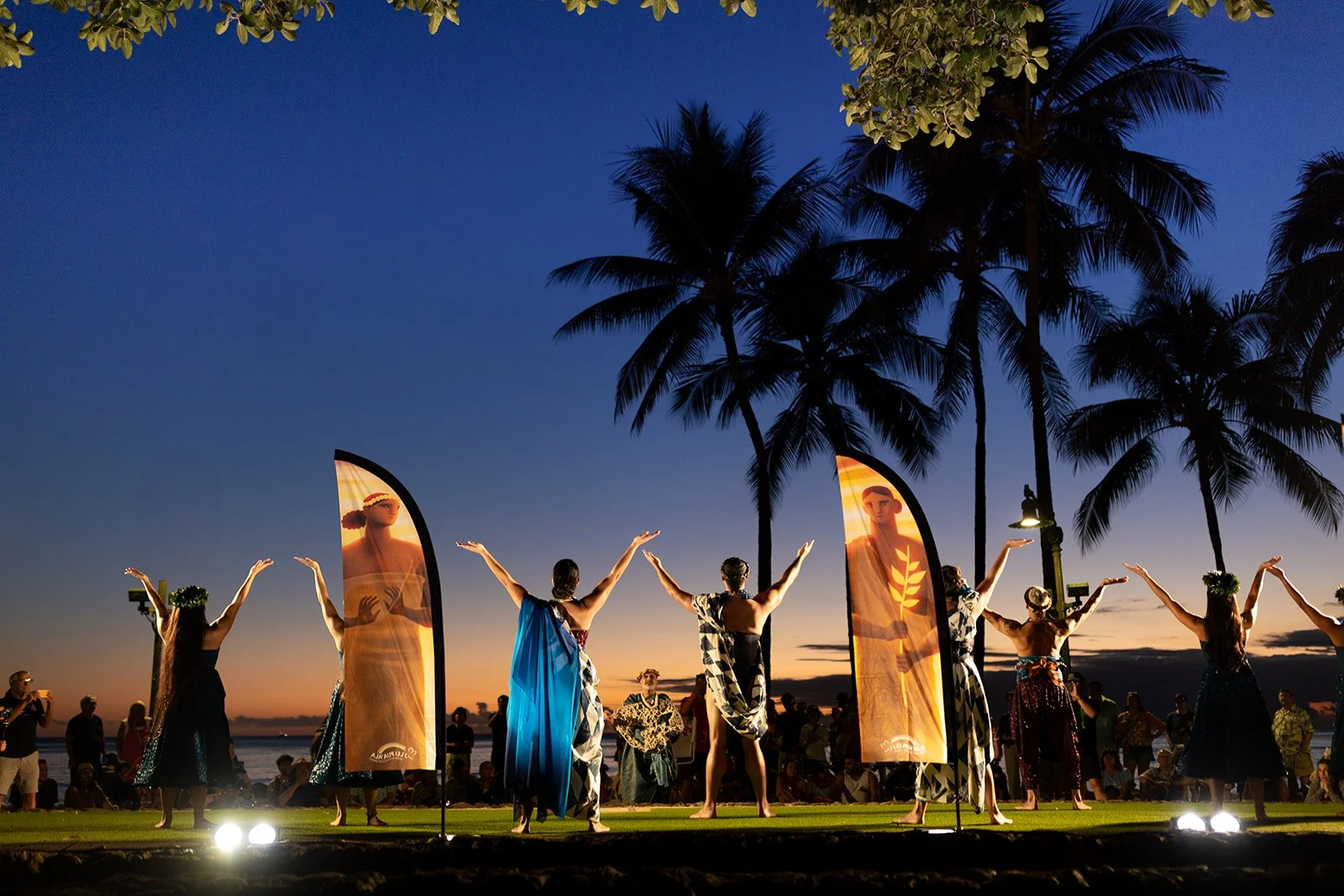
At the opening night of The Return of Kapaemahu hula show in January 2025, Kumu Hula Patrick Makuakāne seemed to have emerged from the ocean itself, opalescent azure fabric softly spilling over his muscular frame and a cape akin to a tangled fish net regally enwrapping his shoulders. Adorned with kukui and lauhala lei, the ensemble was at once familiar and fantastic.
As the sun waded into the horizon off Waikīkī, reflecting rainbow shimmers in the folds of Makuakāne’s tunic, the esteemed choreographer and MacArthur Fellow led his eight-person troupe onto the Kūhiō Beach Hula Mound. Eschewing the usual matching sets, each performer embodied a character in their own exquisitely draped costume. Across from the dancers, a dense crowd had gathered on the beach: members of the local LGBTQ+ and māhū communities, supporters from myriad Hawaiian cultural organizations, city officials, family members, and unwitting tourists who simply walked off Kalākaua Avenue to investigate the hubbub.
Kumu Patrick Makuakāne (center) with cast members, left to right, Moani Wright-Van Alst, Mahie Crabbe, Makenna Kinsler, Ryan Fuimaono, Keola Kamahele, Maluhia Kawai, Kaʻiulani Leong, Mahina Leong. (Mahina Choy-Ellis, Lei Pua ʻAla Collection)
To begin, Makuakāne and dancer Moani Wright-Van Alst blanketed the audience in an oli narrating the origins of the Hawaiian Islands. Then the troupe launched into the moʻolelo of Kapaemahu, which tells of four Tahitian healers who, long ago, arrived on the shores of Waikīkī. They were neither male nor female, but māhū—of dual feminine and masculine mind, heart, and spirit. Through Makuakāne’s signature fusion of traditional hula choreography and theatrical storytelling techniques, the dancers relayed how the māhū shared their healing gifts with the Hawaiian people, then ultimately infused their powers into four boulders and disappeared. Propelled by percussive ‘Ōlelo Hawai‘i chants interspersed with English narration, the journey had the audience enthralled.
Many who had come to watch that night may have unknowingly walked past the very stones the story describes—which today sit mere yards from the hula mound—as do hundreds of beachgoers daily. The Return of Kapaemahu, which ran weekly in the same spot for the following year, intended to change that. It was designed as a multifaceted homecoming—a purposeful reclamation of the stones’ long-censored history; of reverence for māhū identity sullied by colonial forces over time; and of Waikīkī as a once-thriving site of Kānaka ʻŌiwi (Native Hawaiian) culture. For producers Joe Wilson and Dean Hamer, directors of Lei Pua ʻAla Queer Histories of Hawaiʻi, a project aimed at illuminating and honoring gender and sexual diversity in the islands, it was also the culmination of more than a decade spent working to uncover, verify, and amplify the true origin of the stones.
From right to left, Carmela Resuma, Hawaiian Council; Krishna Jayaram, Managing Director City & County of Honolulu; Camille Wong and Aiko Yamashiro, Hawaiʻi Council for the Humanities; and Dean Hamer & Joe Wilson at the premiere of The Return of Kapaemahu, January 22, 2025
(Mahina Choy-Ellis, Lei Pua ʻAla Collection)
They couldn’t have anticipated how the world would change in that time. Just one week after the show’s premiere, Donald Trump began his second term as U.S. President. Among his first actions: executive orders proclaiming that the United States government would only recognize two sexes—male and female—and that all government-funded diversity, equity, and inclusion programs would be dismantled.
For the Kapaemahu crew, this only fueled their motivation to uplift māhū and LGBTQ+ people and educate any detractors. “We just wanted to spread the message that, if you're from Texas or from Florida or wherever, you don't have to believe this,” says Hamer, “but you have to respect that you’re in Hawaiʻi now, and this is the way things are here.”
Reflecting on the impact a year later, Wilson’s eyes well up. “Little did we know, at this moment when the world was beginning to experience these unimaginable attacks on people who, after decades of fighting, finally had a glimpse of what freedom could look like, then had that ripped away…that we would have an opportunity to do something so joyful here,” he says. “And that's what it's been ever since, even as the attacks have worsened.”
It wasn’t until 2012 that Wilson and Hamer themselves first learned about the Kapaemahu stones, known as Ka Pōhaku Kahuna Kapaemahu. They were filming a documentary about Hinaleimoana Wong-Kalu, a celebrated Kumu Hula and māhū cultural leader, when she off-handedly shared the then little-known mo‘olelo (historical legend) with the couple. As history buffs and long-time LGBTQ+ rights advocates, the pair couldn’t stand that the account wasn’t more widely acknowledged.
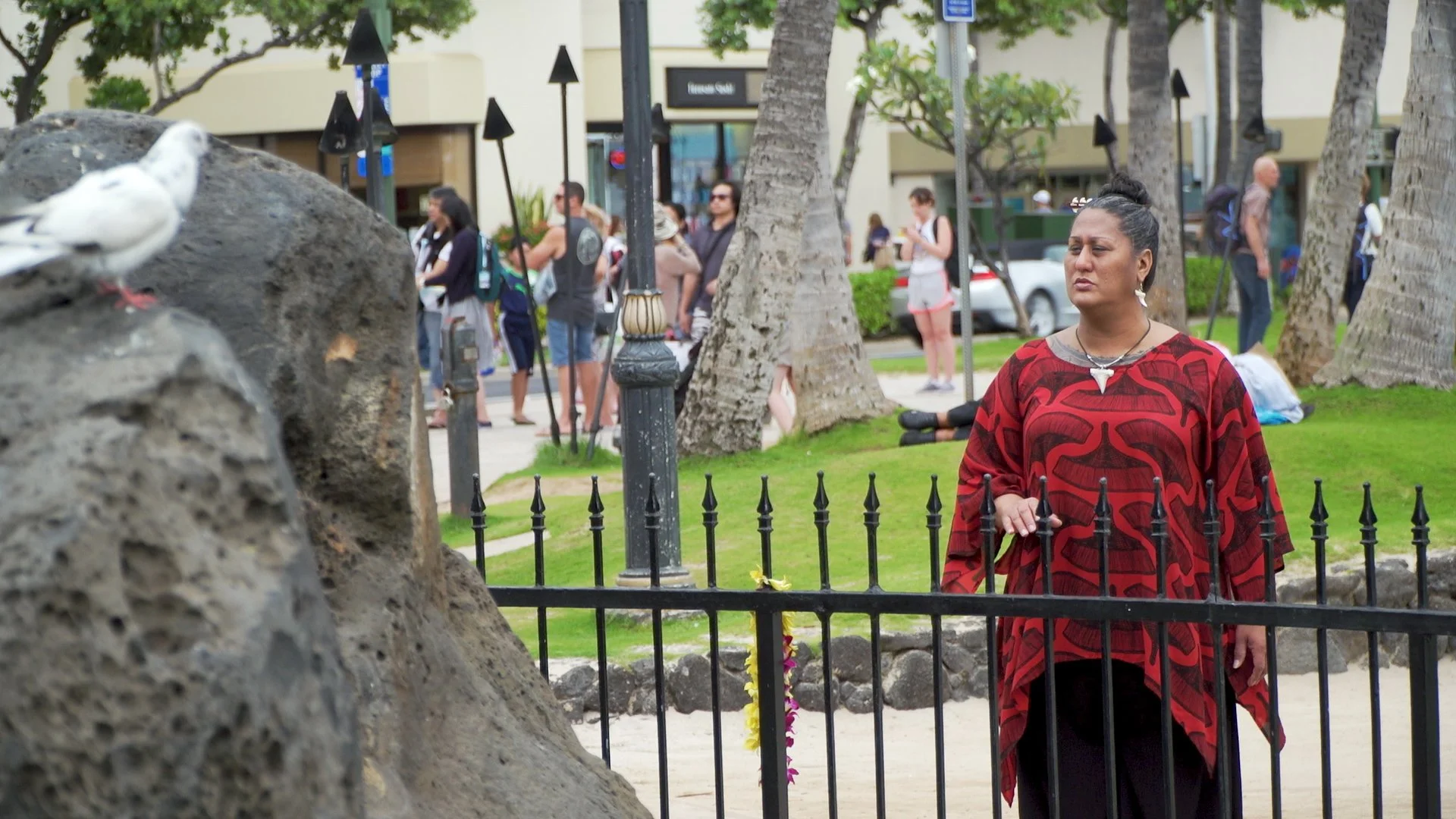
Hinaleimoana Wong-Kalu at The Healer Stones of Kapaemahu in 2012. (Lei Pua ʻAla Collection)
For years, they sifted through archives in search of primary evidence proving the mo‘olelo’s place in the cultural record. Then in 2016, they encountered a handwritten manuscript within the papers of Hawaiian Almanac and Annual publisher Thomas Thrum. It was a near-exact retelling of what Wong-Kalu had told them, transcribed from an oration by Hawaiian military official and Queen Lili‘uokalani confidante James Aalapuna Harbottle Boyd at the turn of the 20th century. Finally, there it was—undeniable.
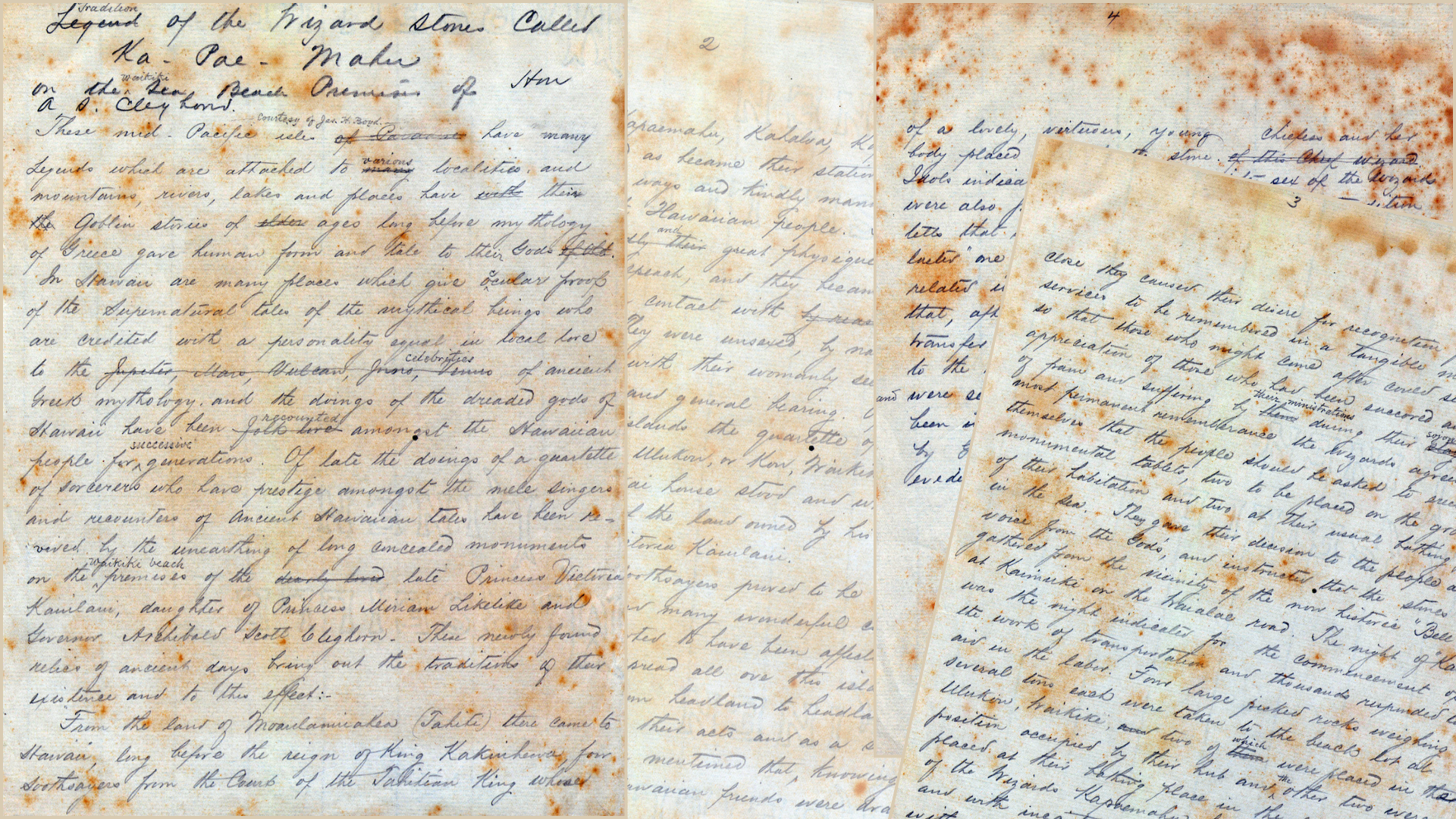
Original manuscript written in English by Thomas Thrum as conveyed by James Aalapuna Harbottle Boyd. (Bishop Museum)
Why then, hadn’t the history endured? Piecing together archived photographs and newspaper clippings, the duo reconstructed a story of suppression. For hundreds of years after the healers disappeared, Hawaiians honored the boulders as a monument to their blessings. But as Western businessmen carved up Waikīkī in the mid 1800s, the stones ended up on private property. In 1941, a developer bought the land and erected a bowling alley, literally burying the monument under its foundation. It wasn’t until the City and County of Honolulu demolished the building in 1962 that the relics were finally excavated. But their true legacy remained underground.
On the continent, the federal government had been systematically purging gay and lesbian employees in what became known as the Lavender Scare—and its prejudices had invaded the islands. Just one week after the stones were unearthed, then Governor John Burns enacted an anti-crossdressing law that required any transfeminine māhū to wear a pin reading, “I Am a Boy.” When local government resurrected the monument the following year, the accompanying plaque made no mention of māhū. A century of Christian missionary erasure compounded by American moral panic had done its work. The once-revered label had been ground down into a slur.
“That was really what fascinated us,” says Hamer, “the combination of an ancient story that acknowledged māhū as respected people, and at the same time, the recent history of how colonization is continuing to screw things up.”
For Wilson, Hamer and Wong-Kalu, the next step was creating their own Hawaiian-language telling of the story that chronicled not just the stones’ origins, but their subsequent concealment and recovery. Over the next ten years, they adapted that script into an acclaimed animated short film, an illustrated children’s book, and a sweeping exhibition at the Bishop Museum that celebrated not just Kapaemahu, but the history of māhū identity and Indigenous Hawaiian medicine as a whole. In 2023, they went even further: With a generous grant from the Mellon Foundation, the trio founded the Lei Pua ʻAla Queer Histories of Hawaiʻi project, an expansive initiative combining deep historical research, multimedia storytelling, and public art to uncover and amplify unsung legacies of gender and sexual diversity throughout Hawaiian history.
That same year, the collaborators successfully lobbied the City of Honolulu to install additional signage at the Kapaemahu monument identifying the healers as māhū and telling the story of their initial erasure.
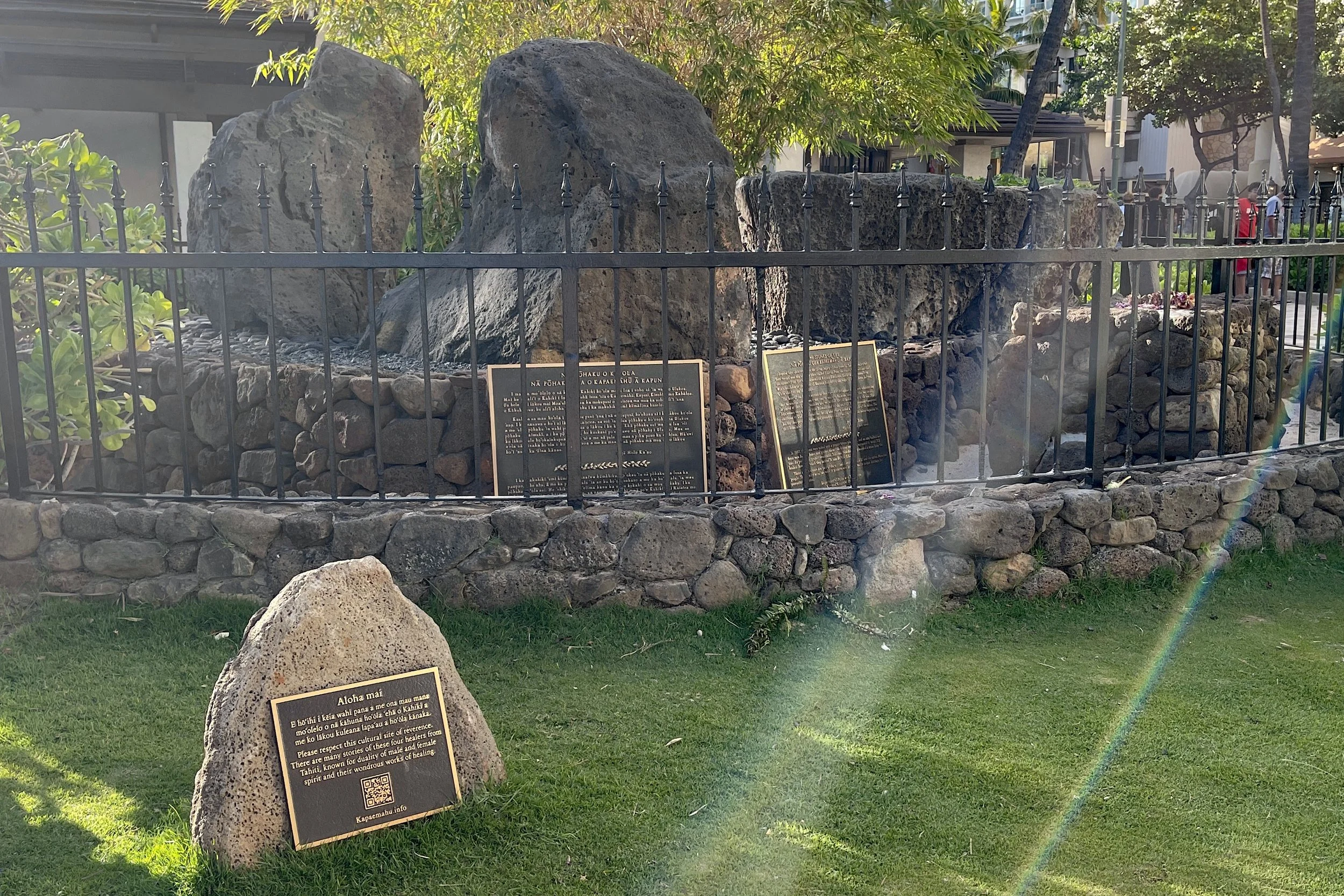
Newly installed plaque at The Healer Stones of Kapaemahu, October 2023. (Lei Pua ʻAla Collection)
Still, they weren’t satisfied with the static text—or even the accompanying interactive timeline. They became determined to create a dynamic living monument, one that utilized the truest form of Hawaiian storytelling: hula. Meanwhile, Makuakāne had adapted their telling of the mo‘olelo into an opening piece for a 2022 show celebrating māhū identity and talent. As the first major commission of Lei Pua ʻAla Queer Histories of Hawaiʻi, they asked Makuakāne to expand the number into its own full production.
Even after decades of boundary-pushing, Makuakāne—who himself identifies as māhū—says he felt called by the material to create something particularly defiant and lasting. He and his musical partner Pat Eskildsen composed a full score for the performance, adapting the Olelo Niihau script into propulsive chants and in some cases combining inherited oli with groovy, contemporary beats. “I love treading that line,” he says, “I love criss-crossing between tradition and evolution.”
For the choreography, Makuakāne sought to evoke māhū essence, but not through the “flamboyance” that often defines queer performance, he says. “The choreography that would express authentically what māhū is for me is something elegant, something unique, something very subtle and nuanced,” he says. “Or you take something that seems very familiar and you just tweak it a little bit, so you look at it and go, ‘Ah, that's odd but yet lovely.’ That's my favorite kind of work.”
At the end of the performance, the dancers exhale into an exuberant adaptation of the beloved song “He Hawaiʻi Au,” originally written by Ron Rocha and Peter Moon. The lyrics tell of traveling the world and upon returning home, gaining a new appreciation for oneself as a Hawaiian. In Makuakāne’s version, however, the classic refrain, “Yes, I am Hawaiian,” has an additional phrasing—“and I am māhū.”
Makuakāne admits he’s a bit surprised he didn’t catch any criticism over the edit—but it wouldn’t have stopped him anyway. “That song is about being your authentic self,” he says. “Some of us are Hawaiian, some of us are Hawaiian and māhū. And so yeah, I'm going to add that—boddah you? Tough shit.”
After an extensive search, Makuakāne brought together an all-Kānaka ʻŌiwi cast, ultimately recruiting members from four different hālau. With only one month to practice, the group not only learned the entire show, but pulled off the remarkable feat of shedding the ingrained differences between their hālau’s techniques to flow together as one unit under Makuakāne’s direction.
Moani Wright-Van Alst, a 45-year-old healthcare worker who stars in the show as one of four healers, hadn’t previously heard the Kapaemahu mo‘olelo. “I was like, this is an amazing, powerful story,” she says. “Why have I grown up in Hawaiʻi my entire life, grown up in hula my whole life, grown up in the Hawaiian community, and never been told this story?”
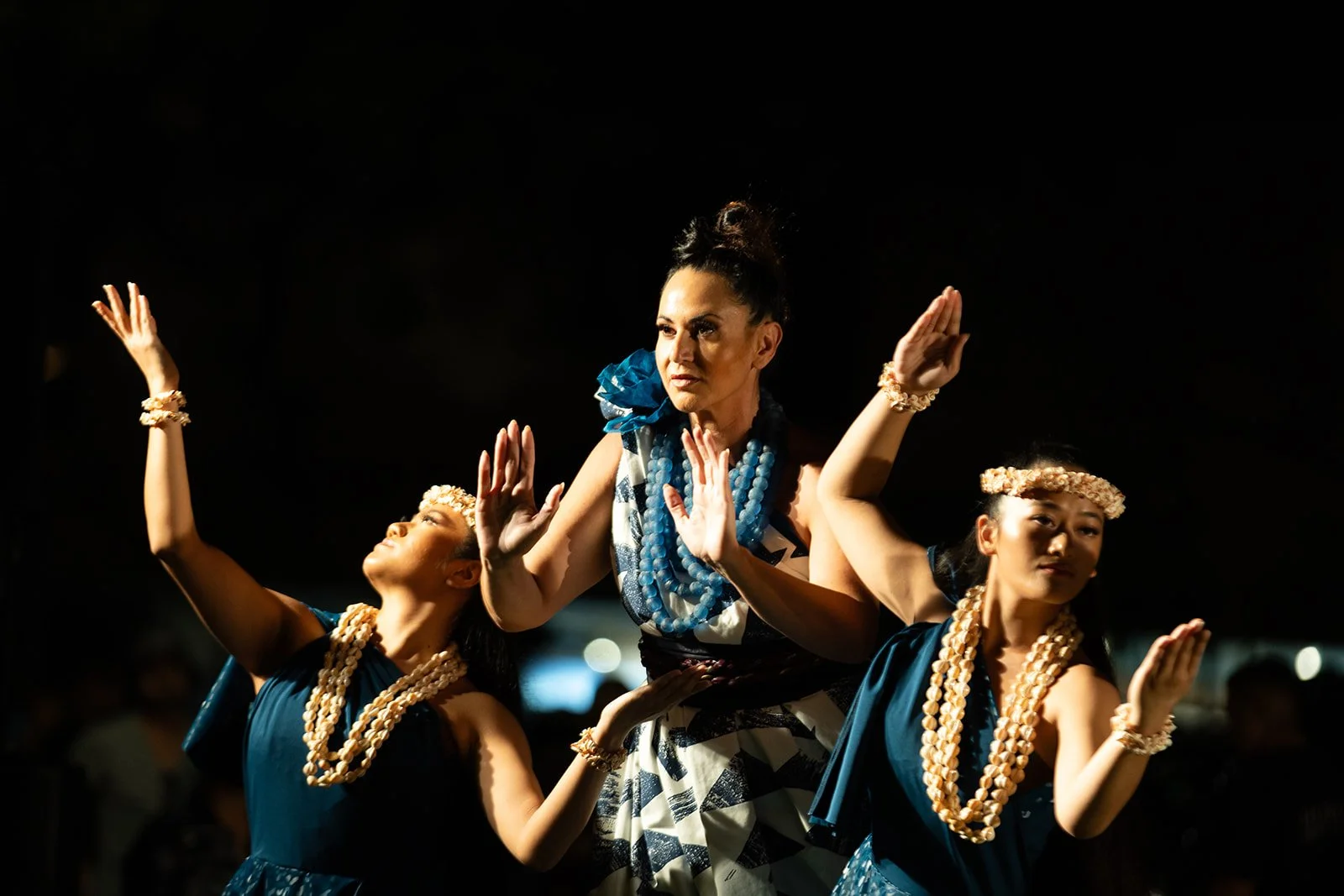
Moani Wright-Van Alst (center) with Kaʻiulani Leong (left) and Mahina Leong (right). (Mahina Choy-Ellis, Lei Pua ʻAla Collection)
Once a young Broadway-hopeful who gave up theater in favor of stability, Wright-Van Alst was drawn to audition by a desire to get back on stage and a years-long aspiration to dance for Makuakāne. But as a mother and LGBTQ+ ally, she also welcomed the opportunity to spread a message of belonging and show her support for māhū in her life. She quickly realized, though, that her support would reach far beyond that. After every performance, she says, at least one crowd member has pulled her aside to share how profoundly the experience moved them or their loved one, usually an LGBTQ+ person who deeply needed to feel seen.
“It's been this opportunity to connect with the audience in an impactful way that a typical Waikīkī hula show doesn't do, quite frankly,” says Wright-Van Alst. “Whether they're māhū, whether they know someone who's māhū, whether they never even heard of the concept of māhū, people leave educated and with some kind of feeling. I think that’s the most important thing one can do as a dancer, which is ultimately as a storyteller—make someone feel something.”
One interaction in particular stuck with Wright-Van Alst. A Native American woman visiting from California told her that during the show, she saw her 12-year-old daughter truly smile for the first time in years. Crying, the young girl opened up, saying she’d long been bullied at school for being gay, and that she feared she might never fit in. “I just hugged her and said, ‘You just be you, baby,’” recalls Wright-Van Alst. “‘Every culture has people who are gay, who are straight, who are different colors. We are all people. You just be true to who you are.’”
While The Return of Kapaemahu successfully brought Wright-Van Alst back to the stage, it was these unexpected exchanges that ultimately changed her. She entered healthcare to help people, she says—but had been losing the sense that she could make a real difference. The show gave that back. “I could have had the worst day in the whole world, but as soon as I pull up to that hula mound and hug all of my castmates, I feel grounded again,” she says. “And I realize what we're about to do is touch lives…even if it's just one person in that audience, someone's life can be changed for the better.”
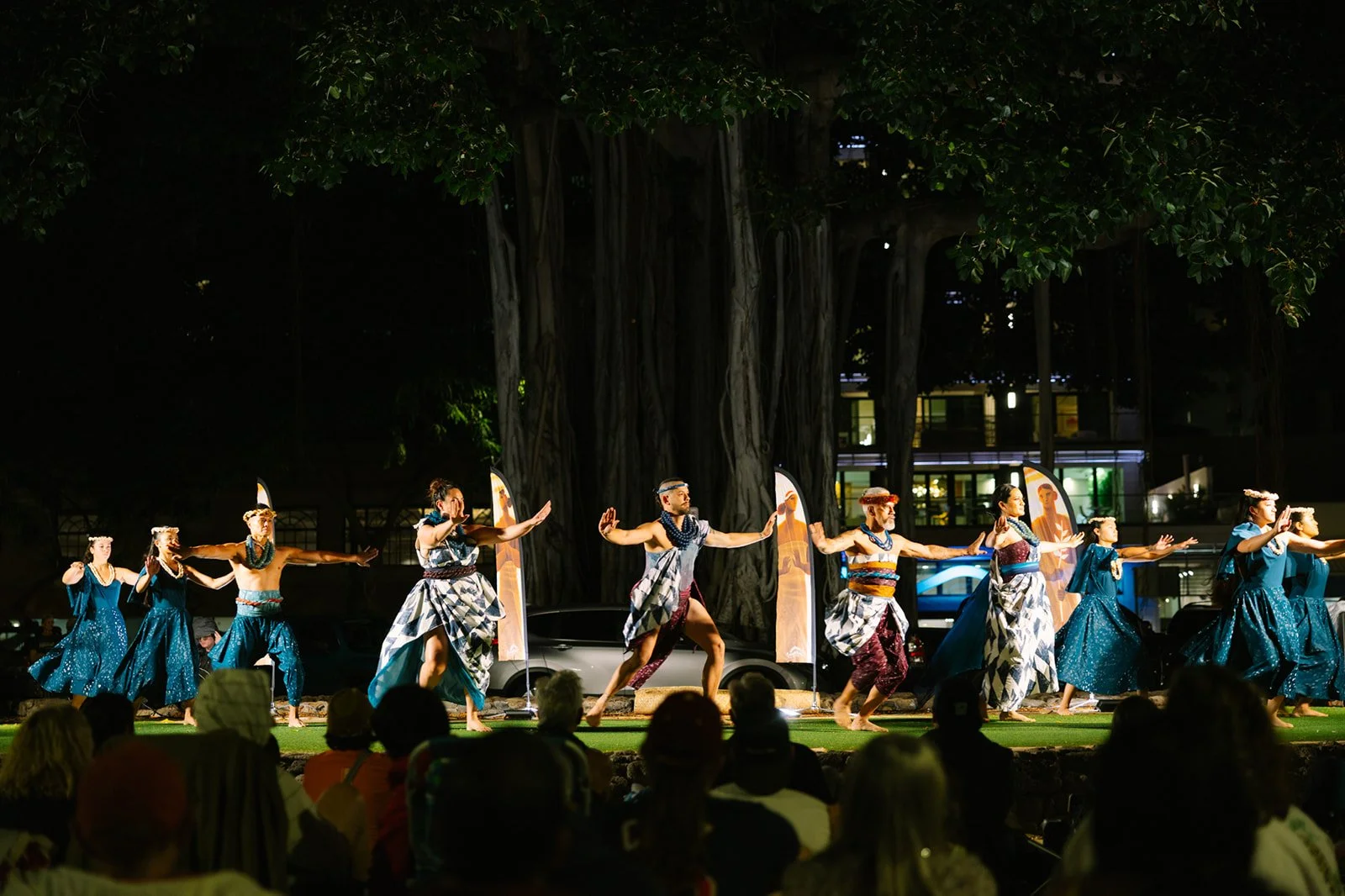
The Return of Kapaemahu cast in the final performance, left to right, Kamaka Bulosan, Hoku Liʻi Liʻi, Kaimana Domingo, Moani Wright-Van Alst, Mauikānehoalani Lovell, Keola Kamahele, Maluhia Kawai, Makenna Kinsler, Mahie Crabbe, Kaʻiulani Leong. (Mahina Choy-Ellis, Lei Pua ʻAla Collection)
During the fiftieth and final performance of The Return of Kapaemahu in January 2026, teary appreciation hung in the warm Waikīkī air as the dancers stepped into their roles for the last time. After the final song, they marched directly off the stage to the nearby stones, beckoning the audience to follow. Standing before the monument to the legendary healers, cast member and Kumu Hula Keola Kamahele—who leads the troupe in Makuakāne’s absence—offered a sweeping oli as the others stood in veneration. The performers then drew together into a close embrace and held each other for what seemed like minutes, unbothered by the crowd that had gathered around them. Over the past year, they had become something more than castmates.
Wilson and Hamer estimate that during its year-long run, approximately 50,000 people experienced the live show—and not one protested or angrily walked off. Amid an environment increasingly hostile to gender-expansiveness, tens of thousands from across the world had learned about the enduring strength of dual feminine and masculine identities, the oppressive forces of colonialism, and the long-overlooked importance of four pōhaku (stones) —all distilled into an hour on a beachfront stage.
For Hamer, that was among the most gratifying parts of the experience: to see a history he had spent years excavating and restoring now presented matter-of-factly, and received as such. "That was kind of thrilling," he says. "That's the story now."
It's a shift increasingly visible beyond the hula mound. When Wilson and Hamer first found the manuscript, they recall that "māhū" still wasn't printable in a mainstream newspaper—too offensive, too esoteric. Today, in part due to the work of the Lei Pua ʻAla project and a rising movement of artists and advocates proudly owning the identity, that’s finally changing. At last, "māhū" is making its return.
After the final show, I spoke with Kalani, attending for the third time. As a gender-expansive Kanaka ʻŌiwi person, she said what most moved her was being acknowledged as part of a lineage—a reminder that, despite everything, it has always been an honor to be māhū. “It's beautiful to see the real meaning of Hawaiian love echoed through the generations,” she said. “[For our ancestors] to say, ‘We're going to put this monument here so that our descendants know that we love them—that they are loved.’”
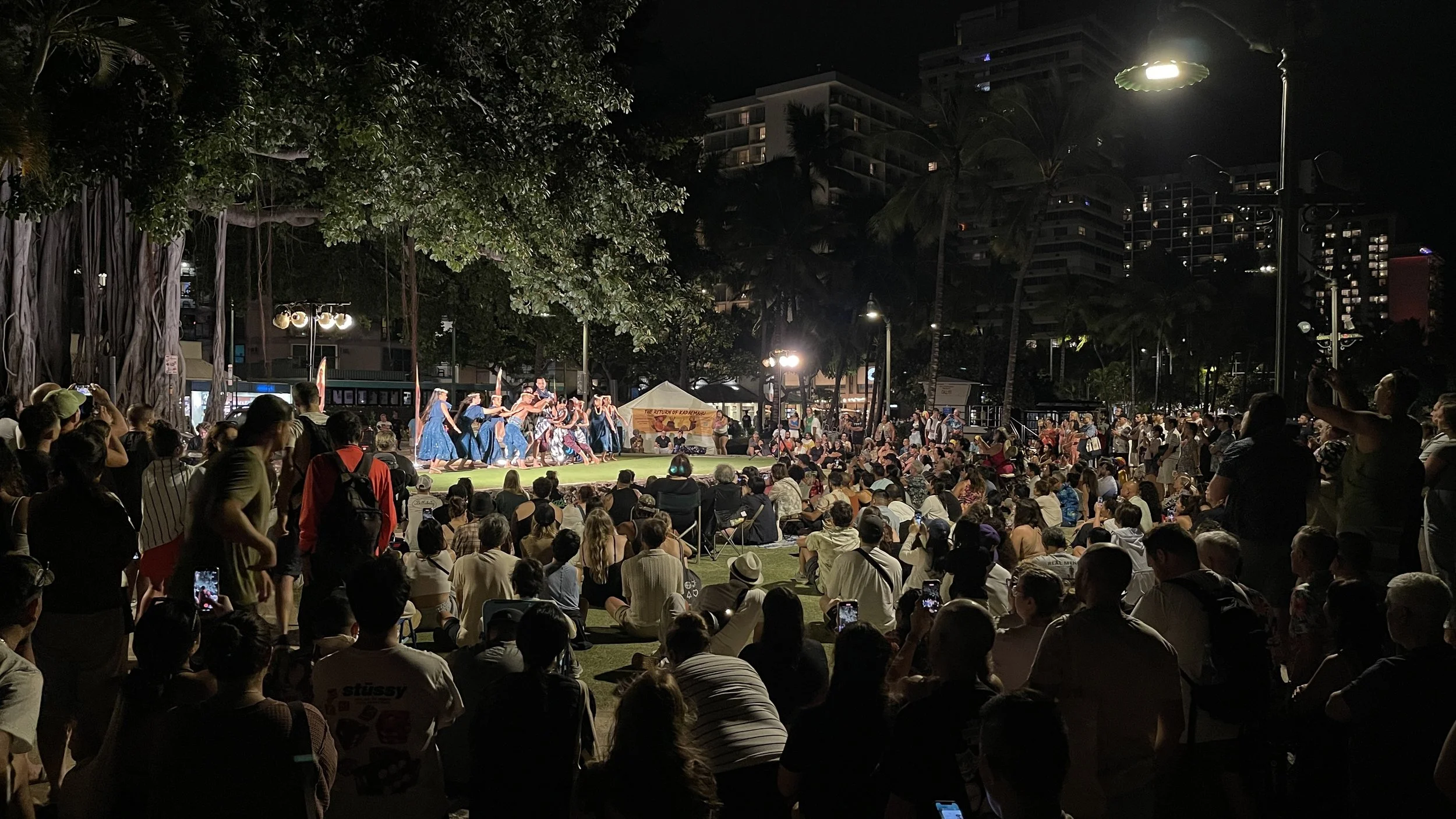
Final performance of The Return of Kapaemahu January 2026 (Lei Pua ʻAla Collection)
Story by independent journalist, former editor-in-chief of Condé Nast’s Them, Sarah Burke.
Banner Image: Kumu Patrick Makuakāne (center) with The Return of Kapaemahu at the January 2025 premiere. (Mahina Choy-Ellis, Lei Pua ʻAla Collection)