

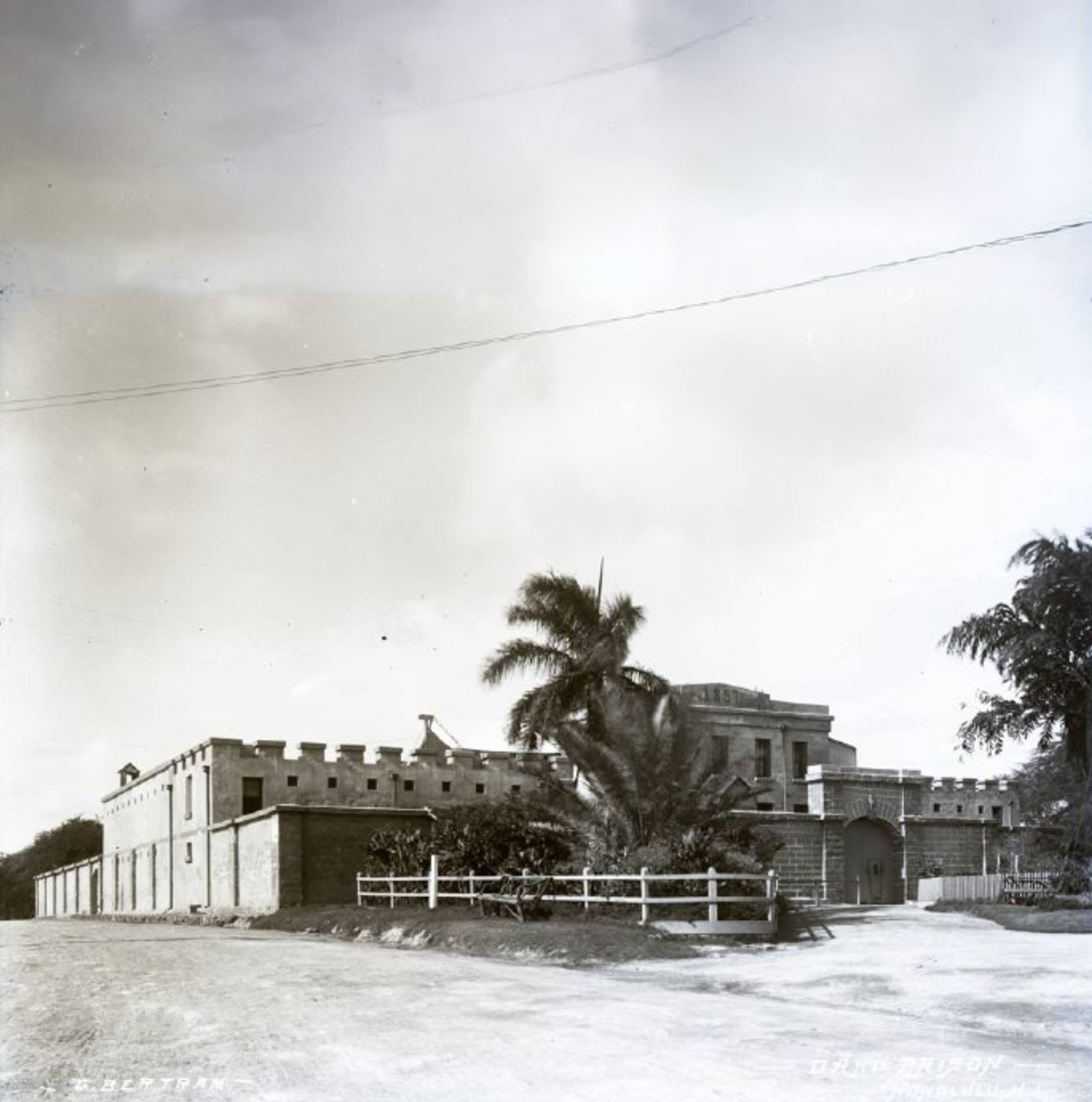
Republic of Hawaiʻi v. Edwards:
New Evidence Casts Doubt on the First Sodomy Case in Hawaiʻi
The Republic of Hawaiʻi v. Edwards (1898) is widely cited as the first sodomy case in Hawaiʻi, a landmark in the islands' journey from initial acceptance through foreign-influenced discrimination to ongoing advancement. Yet while much attention has been paid to the legal issues raised by the case, which spanned a turbulent period in Hawaiʻi's transition from the Republic of Hawaiʻi to a U.S. territory, the details of what actually occurred have never been fully described. Our archival research at the District Court in Honolulu and the Hawaiʻi State Archives has revealed new and surprising details, including a recantation by the sole witness that casts doubt on the entire case.
Background
In early Native Hawaiian society, same-sex relationships, known as moe aikāne, were deeply integrated into the cultural and social fabric, holding a respected place in both moʻolelo and daily life. These relationships were viewed as an honored tradition, with many aliʻi maintaining aikāne, or same-sex partners, as part of the social and political structure.
This cultural landscape shifted dramatically with the arrival of Calvinist missionaries in the early 19th century, who viewed these practices as abnormal and sinful and urged the Hawaiian government to legislate against them as a condition for being recognized as a "civilized" nation.
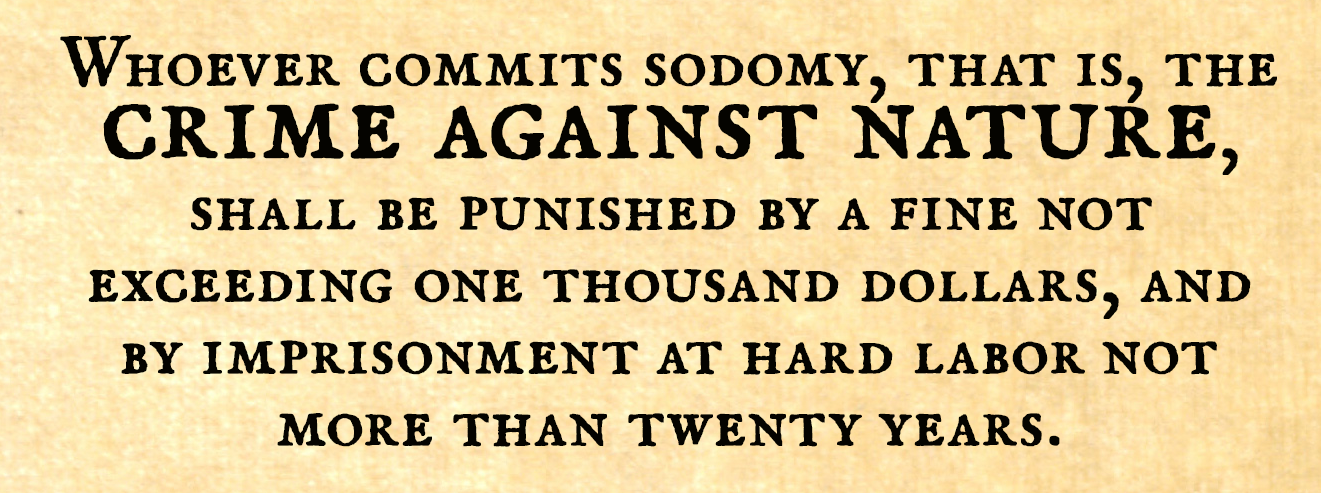
The first such law was promulgated in the criminal code of 1850, which stated that “Whoever commits sodomy, that is, the Crime Against Nature, shall be punished by a fine not exceeding one thousand dollars, and by imprisonment not more than twenty years.” This was remarkably harsh; the fine was the equivalent of $40,000 today, and the maximum prison term was longer than for grand larceny or assault.
Curiously, however, there was not a single recorded prosecution for sodomy during the entire period of the Kingdom of Hawaiʻi. This was not for want of criminalization of sexual activity; adultery and fornication between opposite-sex couples were frequent charges under the category of “moe kolohe,” broadly defined as licentious behavior. Nor is it credible that same-sex desire somehow disappeared or was fully suppressed. Perhaps Hawaiians simply didnʻt believe that there was anything wrong with moe aikāne.
Legal History
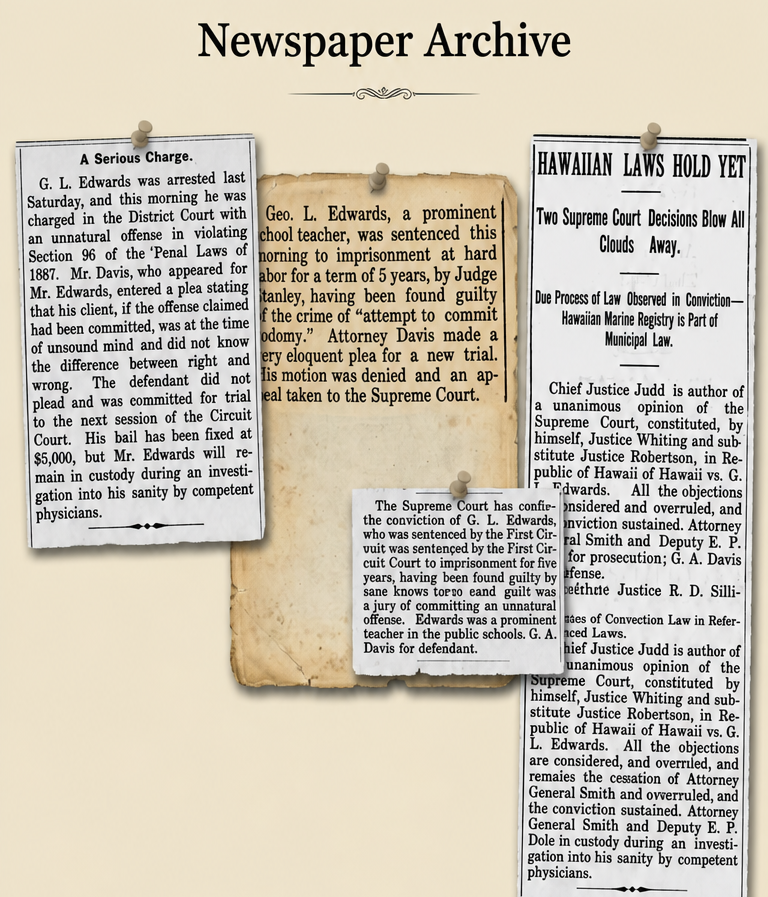
The case began on June 27, 1898 – just a few days before annexation – when G. L. Edwards was charged in Honolulu District Court with an “unnatural offense” of an unspecified nature. His lawyer, George A. Davis, entered a plea stating that if his client did commit such an offense, he was at the time of “unsound mind and did not know the difference between right and wrong.” This was the first of what would become a long and creative series of legal maneuvers to keep Edwards out of jail.
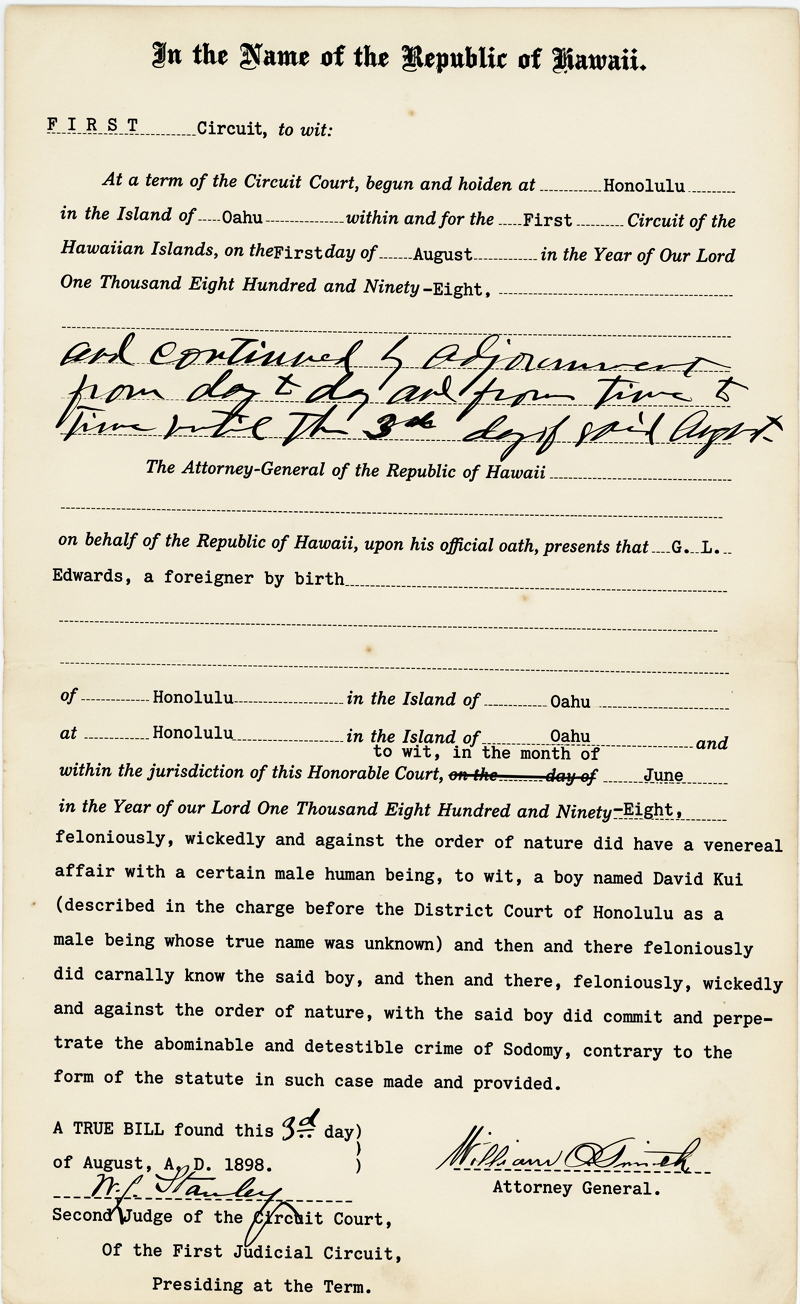
The trial was held on August 16, 1898, at the First Circuit Court, Judge Stanley presiding. The charge was that Edwards, who apparently had been found fit to stand for trial, “feloniously, wickedly and against the order of nature did have a venereal affair with a certain male human being, to wit, a boy named David Kui (described in the charge before the District Court of Honolulu as a male being whose true name was unknown) and then and there feloniously did carnally know the said boy, and then and there, feloniously, wickedly and against the order of nature, with the said boy did commit and perpetrate the abominable and detestable crime of Sodomy.” (The legal system was not coy in its moral assessment of sodomy.)
According to the court record, which has not been previously described, Kui testified that he had been a student at Edward’s school in Kalihi for one year. One day, Edwards asked him to stay after school and locked the doors. After asking Kui’s age and learning he was fourteen (the legal age of consent at the time) Edwards told him to remove his pants then touched him until “the water came out.” On subsequent occasions, Edwards attempted further sexual contact “through the back hole,” but when Kui said it hurt he satisfied himself with frottage. After the final encounter, Kui said he was “all smeared up,” after which Edwards gave him a towel and sent him outside to water the plants. Two of Kui’s schoolmates then testified that they had heard Edwards asking him to stay after school, but there were no further allegations of sexual activity.
Edwards himself was the sole witness for the defense. He denied Kui’s allegations and testified that he had not committed any of the acts described. There was no examination of the details by either side.
It didn’t take long for the jury to reach a verdict: Edwards was not guilty of sodomy, because there was no penetration, but he was guilty of attempted sodomy – a type of charge that Judge Stanley instructed the jury was applicable to any attempt to commit a felony, even if not successful. The sentence was five years at hard labor.
Defense attorney Davis promptly appealed the case to the Supreme Court of HawaiʻI. He argued that some jurors were neither citizens of Hawaiʻi nor sworn to the Republic; that the guilty verdict—supported by only ten jurors—was not unanimous; that the absence of a grand-jury indictment violated the Fifth Amendment; and that the conviction rested on the uncorroborated testimony of a witness who was actually an accomplice. But the Supreme Court, reasoning that the Fifth Amendment protections were not applicable to the Republic at that time and that the lower court’s jury procedures and evidentiary standards were consistent with Hawaiian law, rejected these arguments and upheld the conviction.
Edwards received a second chance to appeal when the Organic Act was passed in 1900, making Hawaiʻi a territory subject to the U.S. Constitution. Attorney Davis promptly filed a writ of habeas corpus on constitutional grounds. A reconstituted Supreme Court ruled 2-1 that because Edward’s case occurred after Hawaiʻi was annexed to the U.S., his prosecution for an “infamous crime” without a grand jury indictment violated the Fifth Amendment. Edwards was freed and does not appear again in any court records, but his case remained important for many years as confirmation that same-sex intimacy, beyond sodomy, was a punishable offense in Hawaiʻi.
Attorney General Files - an unexpected recantation
A search of the Attorney General files in the Hawaiʻi State Archives has revealed new information that raises questions about the facts of the case.
The first document is a typescript of statements made by David Kui and his two schoolmates, Joseph Kaaipoepoe and Daniel Antone, on June 28, 1898, to Marshal A. M. Brown, the top law enforcement official of the Republic. Kui’s statement is similar to his testimony in court, including the exact phrasing used to describe the sexual encounters.
Unexpectedly, his schoolmates also described multiple incidents of sexual activity with Edwards, even though this was not asked about or reported in their brief courtroom appearances. The language used to describe these incidents is very similar for all three; e.g., they each say Edwards “did bad to me.” One of the boys said he resisted Edward’s attempts at sodomy by holding “the sphincter muscle of my anus tight,” an unusually clinical description.
The second and more explosive document is a handwritten note signed Kawika Kui (Kawika is the Hawaiian equivalent for the English name David).

“I, the undersigned Kawika Kui, do hereby solemnly swear, state and affirm that the statements made by me while in the witness box during the trial of the Republic of Hawaii against G. L. Edwards, charged with sodomy, were not true, said statements were made through anger on my part against said G. L. Edwards. I was too young at the time to fully understand the great wrong I was committing. I also state and affirm that said G. L. Edwards never committed or attempted to commit the crime of sodomy on my person. I make the above statements of my own free will and wish to right as far as it is in my power a wrong which I am now old enough to understand.
Oahu Prison Nov. 25, 1899.
Kawika Kui.
Witnesses: J. Caceres, Sam Alapai
Taken at face value, this recantation suggests that the entire sodomy charge against Edwards was false. One might speculate that David and his classmates were angry with Edwards and fabricated their statements to the police, perhaps with prompting from Marshall Brown, who was eager to demonstrate that the Hawaiian criminal system would no longer tolerate same-sex relations. And perhaps Joseph and Daniel declined to testify in court out of fear of the consequences of perjury, should their lies be detected.
On the other hand, we have no idea how this recantation came to be. What and who prompted it; how did it make its way to the Attorney General; what, if anything, did the Attorneys General office do with this new information; and why was Kui also in Oʻahu prison? Perhaps Kui and Edwards, who was still in jail himself in November 1899, encountered one another again and came to some sort of understanding. We may never have answers to these and many more questions about the facts of this precedent-setting case.
SILENCE OF THE ARCHIVES
There is no simple take-home message from this story. Rather, we are left with a reminder that legal records are not transparent windows into the past. They preserve the accusations, procedures, and judgments of courts and officials, but tell us far less about the lives, relationships, motives, and experiences of the people who appear in them.
This uncertainty does not make the case of Republic of Hawaiʻi v. Edwards unimportant. It shows how precarious the historical record of queer life can be, especially when same-sex intimacy appears primarily through the language of criminal prosecution. If anything, the case invites a more careful history: one attentive to the long presence of same-sex relationships in Hawaiʻi, the foreign legal and moral frameworks imposed upon the islands, and the silences, contradictions, and unequal power embedded in the surviving archive.
Story by Dean Hamer and Joe Wilson for Lei Pua ʻAla Queer Histories of Hawaiʻi.
Legal Cases:
Republic of Hawaiʻi v. Edwards: 11 Haw. 571 (1898). Rehearing 12 Haw 55 (1899)
Ex parte Edwards. 13 Haw 32 (1900)
Newspaper articles:
The Independent, June 27, 1898: A Serious Charge
The Independnet, August 17, 1898: Edwards Sentenced to Hard Labor
The Star Bulletin, November 7, 1898: Hawaiian Laws Hold
The Independent, November 7, 1898: Supreme Court Confirms Conviction
Star Bulletin, July 28, 1900. Sheriff Sued by Edwards
The Honolulu Republican, August 28, 1900. Edwards Let Loose from Prison
Banner Image:
Oahu Prison (also known as "The Reef"), which was built in Iwilei, Honolulu, in 1857 and photographed by Brother Bertram around 1883–1905