

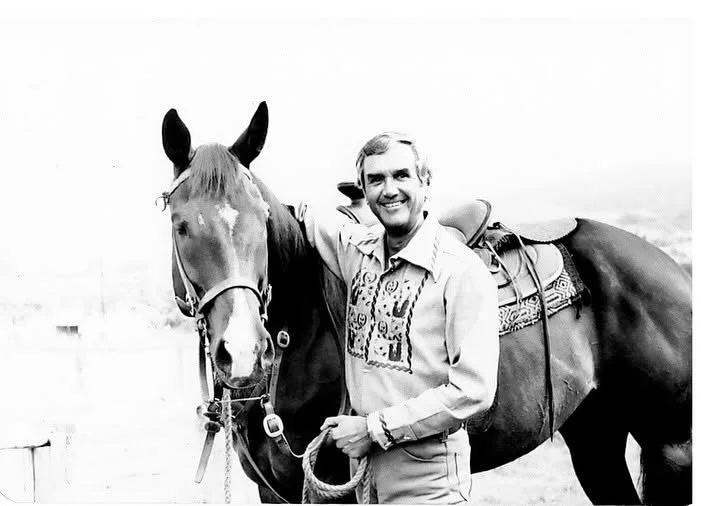
Richard Palmer Kaleioku Smart
of the Historic Parker Ranch
Richard Smart (1913–1992) was an American rancher, theatrical producer, and philanthropist best known as the charismatic owner of Parker Ranch on Hawaiʻi Island, one of the largest privately owned cattle ranches in the United States.
Born into wealth and a heritage that included Hawaiian royalty, Smart was the sole heir to the Parker Ranch legacy through his mother, Annie Thelma Kahiluonapuaopiʻilani Parker. He was educated in California and abroad and pursued a career in the performing arts as a singer and actor on Broadway and in cabaret during the 1930s–40s.
Openly gay among friends though discreet in public during a more conservative era, Smart moved in creative circles in New York and San Francisco before returning to Hawaiʻi in 1959 to manage the ranch. He modernized its operations, preserved its historical legacy, and became a beloved figure in the Waimea community.
One of his closest confidants was Dr. Billy Bergin who joined Parker Ranch at Smart’s invitation in 1970 and served as the ranch’s veterinarian and chronicler of its history for twenty-five years.
In November 2025, Lei Pua ʻAla’s Joe Wilson, Dean Hamer, and DeSoto Brown visited Hawaiʻi Island to talk story with Dr. Bergin about his 2011 book “Richard Smart of the Legendary Parker Ranch” and tour Puʻuʻōpelo, the Victorian-style manner in Waimea that served as the family home for six generations, including for Smart and his two successive longtime companions, Charles Gregory (1942-1985) and Stephen Greenough (1943-1992) both of whom were inurned with Smart in the beautiful columbarium behind the estate.
In a captivating conversation that spanned several hours over lunch in their home, Dr. Bergin shared fond reminiscences of his decades of work alongside Smart at the ranch. His wife Patricia (Cockett) Bergin and their close friend Geraldine Giffin also regaled us with stories of the parties they attended at Puʻuʻōpelu and the good times they enjoyed with Richard and his various lovers and boyfriends over the years.
Dr. Billy Bergin (center) with wife Patricia (left) in their Waimea home with family friend Geraldine Giffin (right)
The point that all three gracious hosts repeatedly made about Smart was an echo of what Dr. Bergin and his co-author, Dexter Keaweʻehu Vredenburg, wrote in their book:
“By the time Richard moved home to take over ranch operations in 1959, he had fully and sincerely developed the character of a consummate gentleman in all aspects of the word. He was unfailingly courteous, never loud or clumsily drunk, and impeccably but not ostentatiously dressed, and decorum was the watchword in his house and at his events. Not unlike many people, he did not like being alone, and his greatest delight was a small dinner with one or two couples at this home in Puʻuʻōpelu or at his houses in Kona or Kahala. His preference was always for well-behaved people who could converse intelligently even when drinking, though some of his intimate companions were not as self-controlled. Richard also enjoyed entertaining ranch supervisors and their wives in his home. These paniolo took pride in the invitations, dressing in their finest attire to be guests of their boss, and were comfortable around him.
On the ranch and around Waimea town, everyone knew Richard was homosexual, and it did not upset or offend most people. The fact that he was open about his sexual preference made him a man that could be trusted, so in popular opinion, what was there to talk about? There were no secrets: he was what he said he was and appeared to be. His forthrightness would have made Smart a great disappointment to modern newspapers, magazines, and electronic media, which thrive on furtiveness and rumor.”
There is much more to the story of Richard Palmer Kaleioku Smart which can be discovered in Dr. Bergin’s book, available in libraries and bookstores across the islands.
This story of Richard Kaleioku Smart, known for this philanthropy and Broadway performances, takes the reader beyond his public persona to a more intimate view of Smart as a father, astute businessman, and visionary rancher. It provides the full spectrum of his life and a true picture of who he was as a person seen through the eyes of his family, employees, and friends who know him best. Always the consummate gentleman, Richard Smart took great pride in his personal achievements and in his native Hawaiian heritage. Hist love for the land―aloha 'āina Paka―and for the employees who toiled there is a touching story of a benevolent patriarch who looks after his ranch family.
Born into wealth and a heritage that included Hawaiian royalty, Smart inherited a legacy of multiple generations of tragedy, heartache, and triumph. Orphaned at an early age after the untimely deaths of both his parents and infant sister, Smart is raised by his grandmother in the elite social circles of Honolulu and California before pursuing his passion for theater and acting in New York. Returning home in 1959 to take control of the family ranch, Smart distinguishes himself in the livestock business, making his mark in the cattle industry of Hawai'i.
Concerned about preserving his legacy for future generations, he unveils a land-use plan for his ranch holdings, the Parker Ranch 2020 Plan, which strategically dovetails with his plans to establish a charitable trust to support the health, education, and welfare of the people and community that he loves.
In this book, the authors pay homage to Richard Smart―cattle rancher and industry leader, wise visionary, Broadway star, humanitarian, and friend.