


Waialeʻe School for Boys
Punishment for Indecent Conduct
In early twentieth-century Hawaiʻi, reform and industrial schools were established to separate children and youth from adult prisons and to reshape them into what government officials considered productive citizens. The largest of these institutions was the Waialeʻe Industrial School for Boys, opened in 1903 on Oʻahu’s North Shore.
Boys were committed there for a wide range of reasons, including truancy, petty theft, “incorrigibility,” and other behaviors that authorities viewed as delinquent. The school emphasized discipline, agricultural labor, and vocational training, requiring boys to work on farms, care for livestock, and learn trades such as carpentry and metalwork. Officials described these programs as rehabilitation, but the schools also provided a source of low-cost labor for both the institution and, at times, nearby plantations.
This 1942 Honolulu Star-Bulletin article reflects another aspect of this system. It reported that a 16-year-old boy convicted alongside several adult men on charges of “indecent conduct” was committed to the Waialae (a misprint of Waialeʻe) Training School for Boys for the remainder of his minority. During this era, young people involved in cases concerning sexuality, including same-sex activity, could be classified as delinquent and sent to reform institutions rather than treated as victims or afforded legal protections. Such commitments were part of a broader system in which courts exercised wide discretion over the lives of minors. The language of “training” and “reform” often masked coercive confinement and strict discipline. Contemporary research has also uncovered evidence of harsh punishments, physical abuse, runaways, and resistance within these institutions.
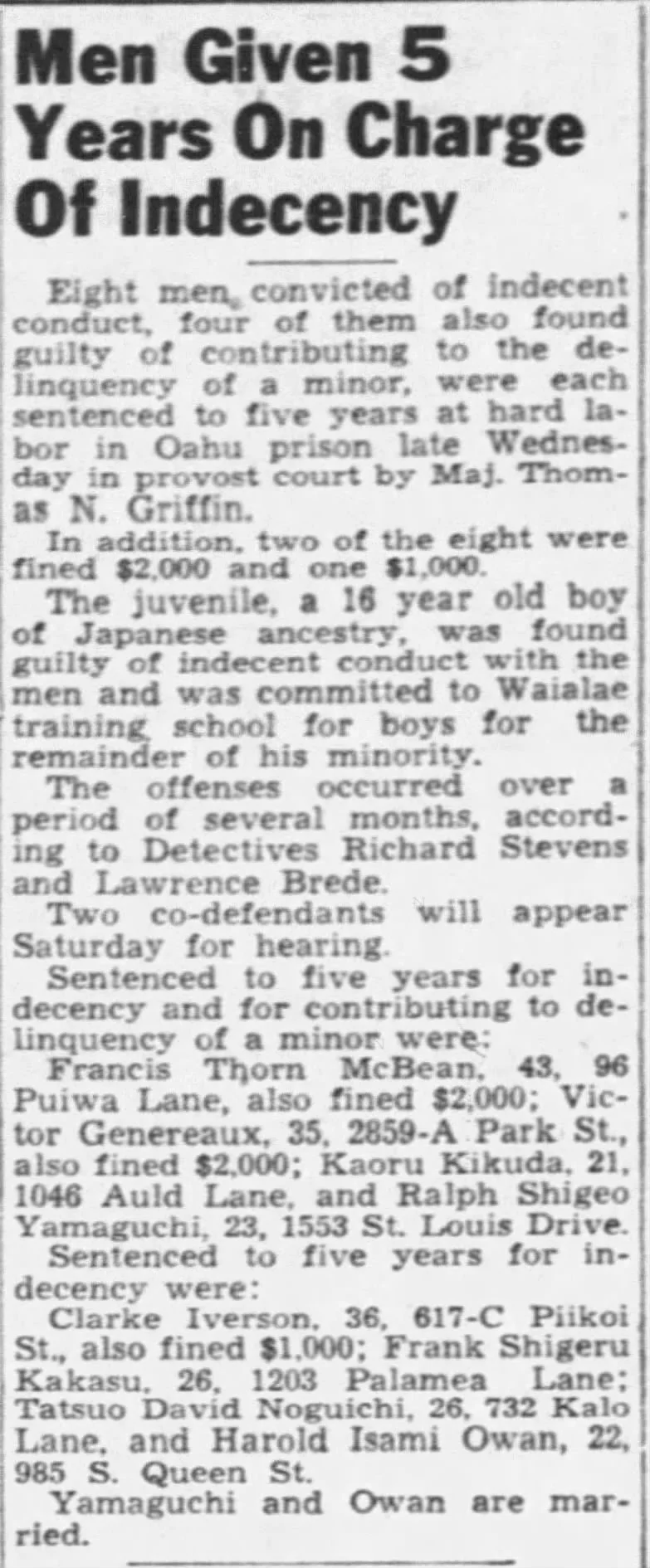
Honolulu Star-Bulletin, July 18, 1942
Historical Context
In the early 20th century, men attracted to men in Hawaiʻi faced systematic policing and criminalization under laws that targeted same-sex relationships and non-normative gender expressions. Influenced by colonial rule and U.S. territorial governance, authorities enforced Western moral codes that sought to suppress Indigenous Hawaiian understandings of sexuality and gender, which had historically been more fluid and accepted.
Laws against "gross indecency" and "sodomy" were used to arrest and imprison adult and young men suspected of engaging in same-sex acts. Police conducted sting operations in public spaces such as parks, beaches, and bathhouses, entrapping individuals and subjecting them to public shaming. The legal system often categorized such offenses as "indecent conduct," leading to incarceration in institutions like the Waialeʻe Industrial School for Boys (for minors) and Oʻahu Prison for adults.
Beyond legal penalties, social stigma and the influence of Christian missionary ideals reinforced discrimination against Māhū and LGBTQ+ individuals. These laws and policing tactics persisted until the early 1970s, contributing to a culture of fear and secrecy within Hawaiʻi’s queer community. It was not until the final decades of the century, with the rise of LGBTQ+ visibility and activism, that laws criminalizing same-sex relationships began to be challenged and repealed.
Native Hawaiian youth were disproportionately represented in Hawaiʻi’s industrial schools, including Waialeʻe and the parallel Kawailoa Training School for Girls. Historians increasingly view these institutions as part of a territorial-era effort to regulate youth, families, and communities while advancing assimilationist ideas about work, discipline, and citizenship. Although some former students later recalled positive experiences and skills they learned there, the schools remain a complex and often painful chapter in Hawaiʻi’s social history.
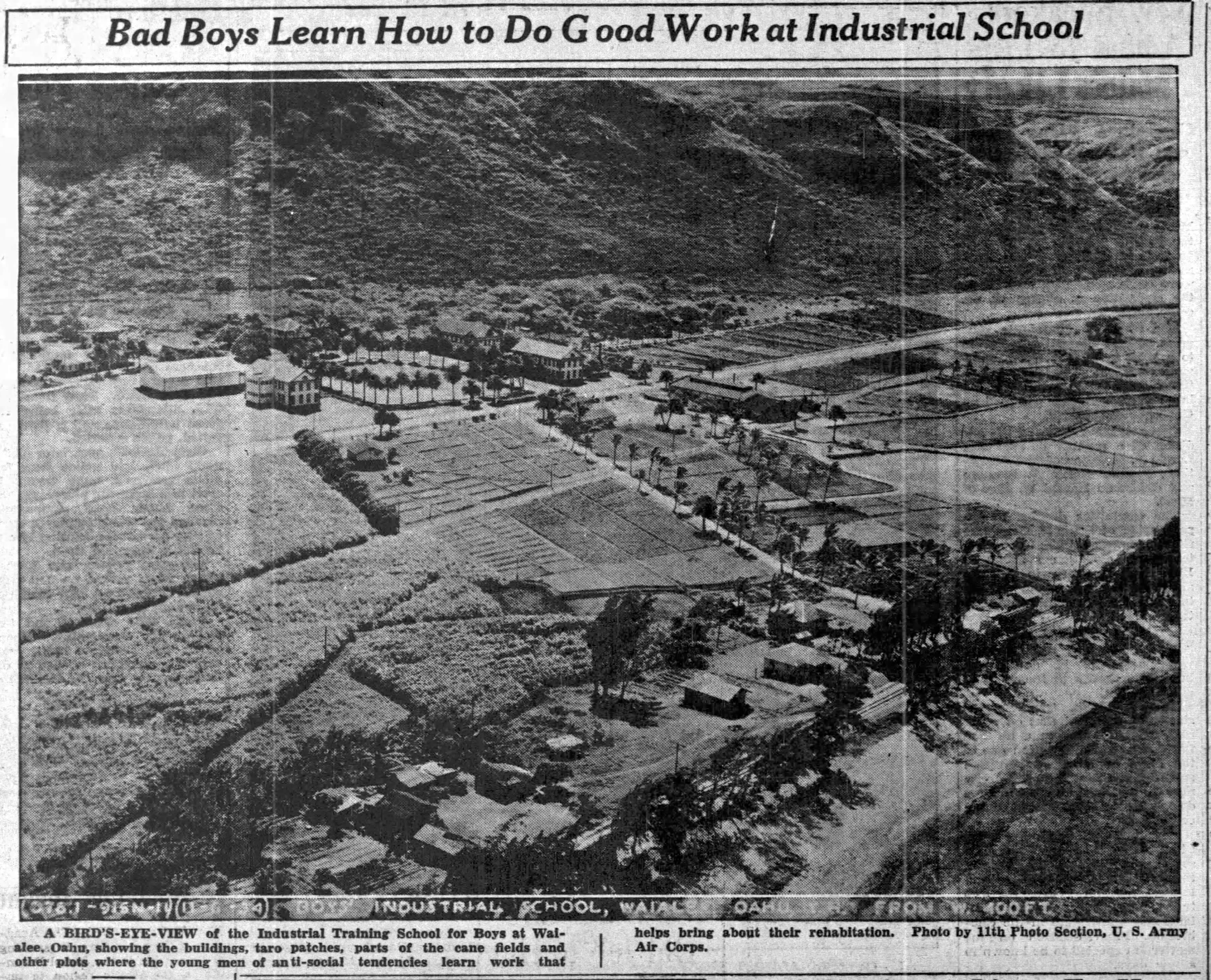

Honolulu Advertiser, February 6, 1935
Story by Joe Wilson for Lei Pua ʻAla Queer Histories of Hawaiʻi.
For more information on the history of reformatories and industrial schools in Hawaiʻi, see Nā Lei Poina ʻOle, a team of researches and community leaders whose mission is to not let the children held at such institutions be forgotten.